Sweepstakes casinos · Brief · 8 min read
Sweepstakes casinos: which designs the new statutes and enforcement releases describe, and which they do not
Five state statutes and three attorney-general releases, read feature by feature: the second coin, the casino-style game, the cash or equivalent prize and the purchase. What each text keys on, what it carves out and who it reaches.
The new state texts on sweepstakes casinos do not all describe the same product. Read side by side, they pick out different features: a second coin, a casino-style game, a cash or equivalent prize, a purchase. This brief sets five statutes and three attorney-general releases against those four features, and says what each text leaves outside. It makes no count of actions and no claim about the whole record; it reports what these documents say.
The features the texts key on
California’s section 337o defines an “online sweepstakes game” by four conditions that all have to be present:
(3) “Online sweepstakes game” means a game, contest, or promotion that meets all of the following conditions: (A) Available on the internet or accessible on a mobile phone, computer terminal, or similar device. (B) Utilizes a dual-currency system of payment that allows a person to play or participate with direct consideration or indirect consideration, and for which the person playing or participating may become eligible for a prize, award, cash, or cash equivalents or a chance to win a prize, award, cash, or cash equivalents. (C) Simulates gambling, which, for purposes of this section, includes, but is not limited to, any of the following: (i) Slot machines. (ii) Video poker. (iii) Table games, including, but not limited to, blackjack, roulette, craps, and poker. (iv) Lotteries, as defined in Section 319. (v) Bingo. (vi) Sports wagering. (D) Awards cash or cash equivalents.
A game missing one of the four conditions is outside the definition as written.
New York’s section 912 uses the same three elements, in fewer words:
that utilizes a dual-currency system of payment allowing the player to exchange the currency for any cash prize, cash award or cash equivalents, or any chance to win any cash prize, cash award or cash equivalents, and … casino-style gaming, including but not limited to, slot machines, video poker, table games, lottery games, bingo, or sports wagering. The state gaming commission shall determine what constitutes a dual-currency system pursuant to this paragraph.
The New York text assigns the meaning of “dual-currency system” to the State Gaming Commission. The brief states no rule because none was read.
| Feature | California § 337o | New York § 912 | New Jersey c.128 | Connecticut § 42-301 | Montana SB 555 |
|---|---|---|---|---|---|
| Second coin | Element (B): a dual-currency system | Element: a dual-currency system | Named as one way a sweepstakes can award a prize: “a dual currency system of payment” | Not an element | Not an element |
| Casino-style game | Element (C): simulates gambling, including poker | Element: simulates casino-style gaming, including poker | “Game” includes casino-style games and any game that “mimics or simulates” them | A sweepstakes that “uses a simulated gambling device” or “allows or facilitates participation in” simulated online casino gaming | The statute names “online casinos” |
| Cash or equivalent | Element (D): awards cash or cash equivalents | Exchange for a cash prize, award or equivalent | “Prize or prize equivalent”: cash, merchandise, or a token redeemable for either | No cash element in the text | Payouts of “any form of currency” |
| Purchase | Direct and indirect consideration defined | Not stated in § 912(1)(a) | Paying or proffering something of value | A sweepstakes “not related to the bona fide sale of goods, services or property” | Allows a wager “using any form of currency” |
What each text carves out
The texts say what they leave outside as plainly as what they prohibit. New Jersey lists seven conditions under which a sweepstakes with a paid route is not unlawful gambling:
(1) there exists a method of entry to participate in the sweepstakes at no cost to the participant; (2) any method of entry that is not free to the participant is ancillary to the purchase of food, non-alcoholic beverages, or other merchandise, such as mugs, trinkets, or mementos, not exceeding $20 in value or such other amount to be determined by the Director of the Division of Consumer Affairs in the Department of Law and Public Safety, provided, however, that such other items of merchandise shall not include coins, tokens, or online credits that have no value other than permitting sweepstakes entry or that are able to be exchanged for money or merchandise from the sweepstakes operator or an affiliated company; … (7) the odds of winning any particular prize shall be identical regardless of whether the contest was entered by purchasing an entry or by entering at no cost to the participant.
The act’s other conditions concern sports results, disclosures, tax and minors. Coins are excluded by name.
Connecticut’s text carves out by the sweepstakes’ relation to a real sale and by a grocery exception:
(a) No person shall conduct or promote a sweepstakes or a promotional drawing authorized by the provisions of section 53-278g that (1) is not related to the bona fide sale of goods, services or property, (2) uses a simulated gambling device, or (3) allows or facilitates participation in any real or simulated online casino gaming or sports wagering, unless such person is licensed under chapter 229b. … (d) Nothing in this section shall be construed to prohibit a retail grocery chain from conducting or promoting a sweepstakes that uses a simulated gambling device, provided such sweepstakes is related to the sale of groceries, the prize is not redeemed or redeemable for cash and the prize is only used as a discount to reduce the price of items purchased from such retail grocery chain.
Connecticut’s section reaches sweepstakes and promotional drawings. A game that is not a sweepstakes or drawing is not addressed by this section, and the text read does not say what other Connecticut law applies to it.
Montana’s act is the one text read that states a permitted category in terms of the currency:
The term includes online casinos, by whatever name known, which constitute internet … gambling and therefore are prohibited. This includes but is not limited to any platform, website, or application that knowingly transmits or receives gambling information, allows consumers to place a bet or wager using any form of currency, and makes payouts of any form of currency. (ii) Online casinos that do not allow the use of currency of any kind are not considered a gambling activity and therefore are permitted.
California’s text adds two carve-outs in its own subsections: games and methods of a licensed gambling enterprise, and limited, occasional promotions that are incidental to substantial bona fide sales:
(e) This section does not make unlawful or otherwise restrict lawful games and methods used by a gambling enterprise licensed under the Gambling Control Act or operations of the California State Lottery. (f) This section does not make unlawful game promotions or sweepstakes conducted by for-profit commercial entities on a limited and occasional basis as an advertising and marketing tool that are incidental to substantial bona fide sales of consumer products or services and that are not intended to provide a vehicle for the establishment of ongoing gambling or gaming.
A free route is how an operator’s own rules answer the New Jersey condition. Chumba’s rules describe an online entry request that costs nothing:
(d) Receive Sweeps Coins by completing an online request. (i) Eligible Participants can request free Sweeps Coins by completing each of these steps: (1) sign into the Eligible Participant’s Customer Account; and (2) click on the “Entry Request” link located at the bottom of the platform screen, or corresponding “Entry Request” link located in the App.
A free route is a fact about the rules. Whether it satisfies a state’s text is for the statute; the same rules’ permitted-territory list excludes California, Connecticut, Montana, New Jersey and New York.
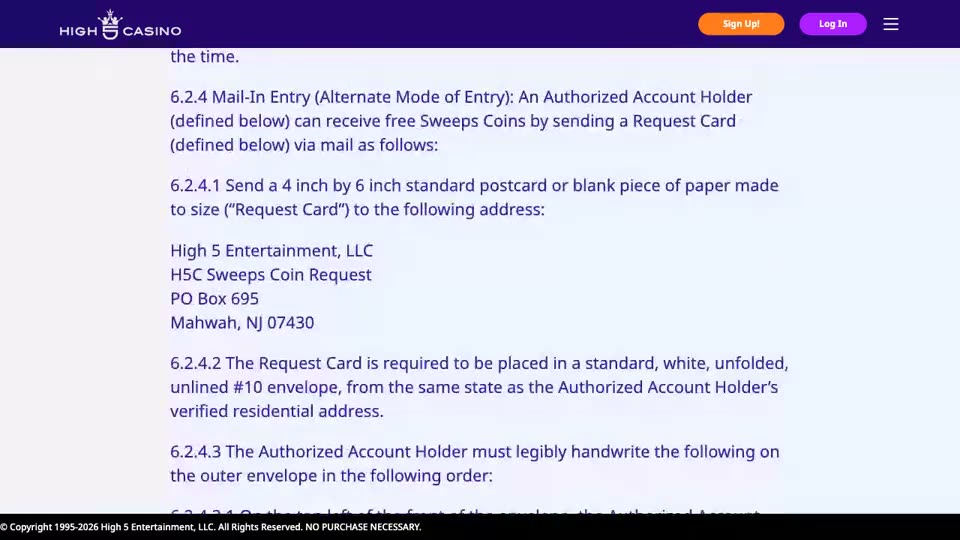
High 5’s rules scrolled through § 6.2.4: the Request Card, the mailing address, the handwriting rules, and three Sweeps Coins per request.
What the releases describe
Three attorney-general releases describe the product they act on. Tennessee’s, on letters to almost forty operators, puts it this way:
Online sweepstakes casinos typically allow participants to play traditional casino-style games like slot machines, table games, or bingo with two types of virtual currencies, one of which can be redeemed for cash or other real-world prizes.
New York’s Attorney General stated the same three features in June 2025, with the purchase in the last clause:
identified 26 online platforms offering players slots, table games, and sports betting using virtual coins that could be exchanged for cash and prizes. … Players typically purchase these virtual sweepstakes coins as part of a package with other virtual currency.
Kentucky’s release, on lawsuits filed in June 2026, describes its allegations the same way:
The sweepstakes casino games are designed to look and feel like traditional casino games with slot machines and blackjack games. … The online casinos offer two types of chips – one for free and one with a cash value. Users pay real money for so-called Sweeps Coins just like gamblers pay for poker chips at a real casino. They are also able to cash out their winnings.
These are allegations in a lawsuit. No court has decided them.

Chumba’s public Promotions page: a top banner offering GC10M for $10 “plus FREE SC30”, then the Purchase offers section with a welcome offer of GC 2,000,000 + SC 2. A paid Gold Coin pack with Sweeps Coins added is the pairing this definition describes.
Each of the three releases describes a product with a second, redeemable coin, casino-style games and a purchase package. None of the three describes a game with no redemption, a promotion tied to a purchase of goods or a skill contest. That is a statement about these three documents, and the statutes above are the place to read where each model sits.
What a builder does with this
- Read the four features as a checklist against each text: a second coin, a gambling simulation, a cash or equivalent award, a purchase. California requires all of its conditions together; Connecticut and New Jersey key on other facts, and Montana keys on currency.
- Treat each carve-out as a design condition. New Jersey’s seven conditions, Connecticut’s bona fide sale and grocery exception, California’s limited and occasional promotion and Montana’s no-currency online casino each come with conditions in the text.
- Check the reach, not just the product. California and New York also name the supplier layers, which the series A deep dive sets out; Connecticut reaches anyone who conducts or promotes a covered sweepstakes.
- Note what the texts leave to others: New York leaves “dual-currency system” to its Gaming Commission, Connecticut’s section does not address a game that is not a sweepstakes or drawing, and none of the five contains a skill element, which the next brief takes up.
- Treat none of this as a safe harbor. These are the texts read on October 16, 2026; each state’s courts and agencies decide what they mean.