Sweepstakes casinos · Deep dive · 18 min read
Sweepstakes casinos: the business, the economics, and where a startup fits
How a dual-currency casino earns its money, what the published rules, SEC filings and court records say about its costs, which layers of the stack the California and New York statutes name, and where the public record shows a new company could build.
A founder looking at sweepstakes casinos sees a lobby of slots and a coin store. The business behind the lobby has a revenue mechanic, a set of cost lines and a stack of suppliers, and two states have written statutes that name the suppliers. This piece sets out what the public record says about each. It uses the operators’ own rules, SEC filings, court filings and the text of the statutes, and it says “not stated” where no record gives a figure.
One fact shapes everything that follows. The filings read for this piece contain no revenue, cost or margin figure reported by an operator of the dual-currency model, because the operators read are private. The one revenue figure for such a business that appears in a public record is an allegation in a state complaint, and the article quotes it as that. The benchmark figures come from a listed developer of traditional social casino games, and the article says so each time. The legal analysis of the model sits in the sweepstakes series and the contests series; this piece links to them rather than restating it.
How the coins work, in the operators’ words
A dual-currency casino sells one coin that cannot be redeemed and gives away a second that can. Chumba Casino’s rules describe the first route to the redeemable coin as a bonus on a purchase:
(a) Receive Sweeps Coins as a free bonus when purchasing Gold Coins. Each Eligible Participant may receive Sweeps Coins as a bonus upon the purchase of specifically marked packs of Gold Coins. Gold Coins can be used for social game play in Chumba Casino. Gold Coins cannot be redeemed for prizes. The number of Sweeps Coins an Eligible Participant will receive as a bonus for each relevant Gold Coin purchase will be stated in the Platform or App purchase window. All purchases of Gold Coins are final and no refunds will be given.
The same clause lists three further routes, including a free request route. This piece is about the purchase route because it is the one that carries the revenue; the sweepstakes series covers the free route and the legal test.
The operator’s public promotions page shows what a purchase offer looks like. The banner and the welcome offer, read on October 16, 2026:
Score your exclusive first-time offer GC10M for $10 plus FREE SC30! Claim Now … Welcome offer Sign up to claim your peachy welcome offer! GC 2,000,000 + SC 2
The page states one price, $10, and the coins attached to it: 10 million Gold Coins and 30 Sweeps Coins on the first-time offer. It states no price for the welcome offer. Other pack prices sit behind the store, which the page does not show.

Chumba’s public Promotions page: a top banner offering GC10M for $10 “plus FREE SC30”, then the Purchase offers section with a welcome offer of GC 2,000,000 + SC 2. A paid Gold Coin pack with Sweeps Coins added is the pairing this definition describes.
The rules then say what a Sweeps Coin is worth, and what has to happen before it can be redeemed:
4.4. Each Sweeps Coin that has been won through game play (rather than collected using one of the methods described in clause 3 of these Sweeps Rules) can be redeemed for a prize with value being equivalent to US$1. … 4.6. Unless Sponsor/Promoter requires otherwise, any Sweeps Coins allocated to an Eligible Participant are required to be played once before they are eligible to be redeemed for prizes. … 6.5. Sponsor/Promoter will only process a prize redemption if the redeemed value of the prize is US$100 or more (i.e. a minimum of 100 eligible Sweeps Coins).
The New York Attorney General states a finding about the rate at which coins are obtained, in a settlement announcement on September 9, 2026:
An OAG investigation into VGW’s platforms found that, in reality, players could obtain “sweeps coins” the same way one might purchase chips in a casino, receiving approximately one coin for every dollar spent on the platform.
This is the Attorney General’s finding. The Assurance of Discontinuance that resolved the matter records that the respondents “neither admit nor deny” the findings (¶ 13), as the section on exits below quotes.
The rules and the finding together give the arithmetic a builder can check. The worked example below uses only figures the operator and the rules publish, and states its one assumption.
| Step | What the record says | Result |
|---|---|---|
| Price of the first-time offer | Chumba’s promotions page: GC10M for $10 plus FREE SC30 | $10 paid; 30 Sweeps Coins attached |
| Redemption value of a coin won through play | Rules cl. 4.4: US$1 per Sweeps Coin | A coin won through play is worth $1 on redemption |
| Play before redemption | Rules cl. 4.6: played once before it is eligible | The 30 coins have to be played at least once |
| Redemption threshold | Rules cl. 6.5: a minimum of 100 eligible Sweeps Coins | A balance of 30 cannot be redeemed; it has to reach 100 |
| Assumption (ours) | None of these documents states a return to player. For illustration only, assume 95% on each play of Sweeps Coins; not any company’s figure | After one play of 30 coins the expected balance is 28.5 coins; each further play multiplies it by 0.95 |
The example shows structure, not profit. The operator’s revenue is the price of the pack. Its prize liability is whatever players redeem, which depends on how many players reach the threshold, how much they play and how far they win. None of the sources read states those quantities. A builder modelling the business has to supply them from the product’s own data.
Scale and benchmarks: what the record does and does not give
The Florida Attorney General’s complaint against VGW is the one public record that puts a revenue figure on the model. The figures are the State’s allegations, stated in the complaint as facts about a company that the complaint says has since gone private:
Before going private, for example, the VGW Defendants generated annual revenue—for just the year 2025—of more than $5 billion. $3.7 billion of the VGW Defendants’ 2025 revenue was attributable to Chumba Casino alone.
An allegation in a complaint. No court has ruled on it, and the filing does not say which VGW document the figure comes from.
For benchmarks that come from a company reporting its own results, the closest public comparison is a listed developer of traditional social casino games, which sells virtual coins with no cash redemption. PLAYSTUDIOS, which also describes its own sweepstakes product, reports the revenue and the fees. Its annual report gives the size of the business and its direction:
Net revenue decreased $55.3 million, or 19.1%, to $234.1 million during the year ended December 31, 2025 compared to $289.4 million during the year ended December 31, 2024. The decrease was primarily due to a $40.5 million decrease in virtual currency revenue driven by decreases in Average DPU. Advertising revenue decreased $14.5 million driven by a decrease in Average DAU.
DPU is average daily paying users and DAU average daily active users, in the filing’s definitions. This is a traditional social casino business, not a dual-currency one.
The same filing says what the app stores charge, which is the first cost line a web-only operator does not carry in the same way:
The platform providers charge us a transaction fee to process payments from our players for their purchase of in-game virtual currency. These platform fees are generally set at 30% of the in-game purchase.
Its June 2026 quarterly report then splits virtual-currency revenue by where the player paid:
Three Months Ended June 30, Six Months Ended June 30, 2026 2025 2026 2025 Third-party platforms 27,976 41,525 60,821 87,395 Direct-to-consumer platforms 14,691 6,683 27,094 11,654 Total virtual currency $ 42,667 $ 48,208 $ 87,915 $ 99,049
In the quarter, virtual-currency revenue paid through third-party platforms fell from $41.5 million to $28.0 million and revenue paid direct to the company rose from $6.7 million to $14.7 million. The 10-K says direct-to-consumer revenue “incur[s] lower processing fees” and does not state the rate.
The company attributes part of its own revenue pressure to the sweepstakes model. Its risk factors say so in these words:
The continued growth of “sweepstakes casino” games, which typically incorporate promotional sweepstakes mechanics and may offer cash-equivalent prizes, has intensified competition within the broader social casino category. … In addition, marketing and advertising spend across the broader social casino ecosystem has increasingly been directed toward sweepstakes-based products, which may further disadvantage traditional social casino games by increasing player acquisition costs, reducing organic discovery, and compressing returns on advertising spend.
The incumbents that report in SEC filings describe the same competition. Playtika and Light & Wonder name it in their annual reports:
The emergence of “sweepstake casino” games which mimic slot and bingo- … themed games but incorporate sweepstakes as a primary user acquisition and monetization tool in the game could pose a competitive threat to our slot and bingo-themed games and harm our results of operations.
Additionally, the overall social casino industry competes with sweepstakes operators.
The cost lines, from the record
The outline for this series asks for the cost lines a sweepstakes casino carries: content, payments, identity checks, marketing and redemptions. The record gives different amounts of evidence for each, and the piece reports each as the record gives it.
Content
Games come from studios, and the one public filing that states the commercial form describes revenue sharing. Meridian Holdings, formerly Golden Matrix, says so about the content it licenses for its own regulated operations. It does not state a rate:
The Company has established revenue-sharing agreements with such providers to offer a wide variety of casino games, ensuring a diverse and engaging casino experience for the Company’s players via a vibrant and ever-expanding casino game library.
The filing is about the company’s regulated casino offering. It states no rate and says nothing about sweepstakes casinos.
The same company’s earlier results release shows a studio selling into this market:
Expanse Studios: Meridianbet’s proprietary game development arm expanded its North American footprint with five new integrations into U.S.-based sweepstakes casinos.
A listed company describing a content studio’s integrations into U.S. sweepstakes casinos. The release states no revenue for that line.
An operator that bought its games also names the dependency. Hyperscale Data’s fiscal 2024 annual report, describing its subsidiary BNC’s sweepstakes platform, says:
BNC depends significantly on third-party game providers to supply certified, compliance-tested games and core technological features—such as random number generation modules, sweepstakes mechanics, and other elements that users rely on for fairness and transparency.
Payments and identity
The payment line has two parts in the record. The first is distribution: the 30% app-store fee above applies to a game sold through a store, and the PLAYSTUDIOS figures show a company moving revenue to a direct channel. The second is the dependency on payment partners. PLAYSTUDIOS’s risk factor names it:
We rely heavily on third-party platforms, payment processors, banking partners, and other service providers to distribute our games, process payments, and support key compliance functions, and adverse changes to their policies, underwriting standards, or practices could materially harm our business.
The identity line shows in the operator’s rules. Chumba pays cash out over the rail the player paid on, and ties the prize to the account holder:
6.3. Where an Eligible Participant has chosen to redeem prizes for cash, the payment will be made in USD to the financial account or online wallet from which the Eligible Participant purchased Gold Coins, or if this is not technically possible, then to an alternative bank account the Eligible Participant nominates. … (b) THE ELIGIBLE PARTICIPANT’S DETAILS MUST MATCH THOSE OF THE ELIGIBLE PARTICIPANT’S CUSTOMER ACCOUNT. In Florida, the maximum redemption value of a Sweeps Coins prize won on any one spin or play, via an Eligible Participant’s participation in the Sweepstakes is US$5,000. … 6.8. Sponsor/Promoter reserves the right, in its sole discretion, to limit an Eligible Participant’s redemption of Sweeps Coins to US$10,000 per day or any other amount over any time that Sponsor/Promoter considers necessary to satisfy its regulatory obligations or the requirements of its partners and suppliers.
The rules show three design choices with a cost: payout back to the paying rail, a per-play cap in one state and a discretionary daily cap. They state no processing fee or verification vendor.
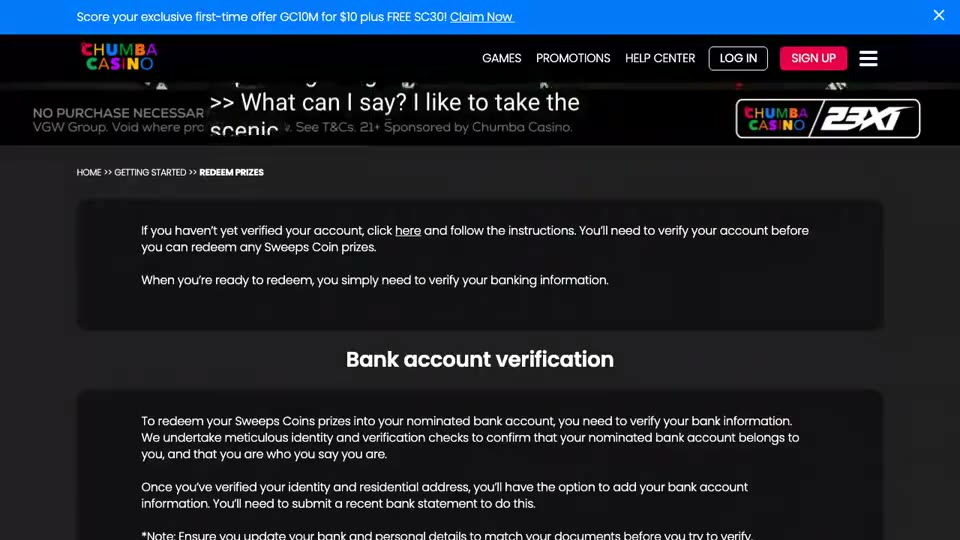
Chumba’s public guide to redeeming prizes, at “Bank account verification”: to redeem Sweeps Coins prizes into a nominated bank account the player first verifies identity and bank details, and the bank statement must show the bank name, the account owner’s name, the account number and the clearing number. The cash leg ends in an account in the player’s own name.
Marketing and partners
The record has no operator’s marketing spend. It has two statements about how marketing works in the segment. PLAYSTUDIOS, quoted above, says advertising spend across the category is moving toward sweepstakes products. A listed media company describes the partner-led alternative in its shareholder presentation:
Triller Sweeps: Partner-Led Monetization Channel A capital-light way to monetize legacy audience scale while Project Eight is being activated 14 What we contribute • Audience • Brand • Distribution • Market visibility • Eight ecosystem integration What partner contributes • Operating infrastructure • Sweepstakes / gaming execution • Day-to-day compliance and operations
The slide describes a model in which the audience owner contributes brand and distribution and a partner runs the operation. It states no revenue or revenue split.
Leaving a state: redemptions, exits and enforcement
Two records show what leaving a state involves. High 5’s current rules, dated October 14, 2026, give players in one state a two-step wind-down:
AS OF OCTOBER 15, 2026, PARTICIPANTS LOCATED IN THE STATE WILL NO LONGER BE ABLE TO REGISTER NEW ACCOUNTS FOR HIGH 5 CASINO AND EXISTING PLAYERS WILL NO LONGER BE ABLE TO MAKE PURCHASES ON THE PLATFORM. PLAYER’S WITH EXISTING ACCOUNTS WILL BE ABLE TO CONTINUE TO PLAY AND REDEEM SWEEPS COINS UNTIL OCTOBER 29, 2026.
Purchases stop first and redemptions continue for 14 days after. The notice gives no reason for the change.
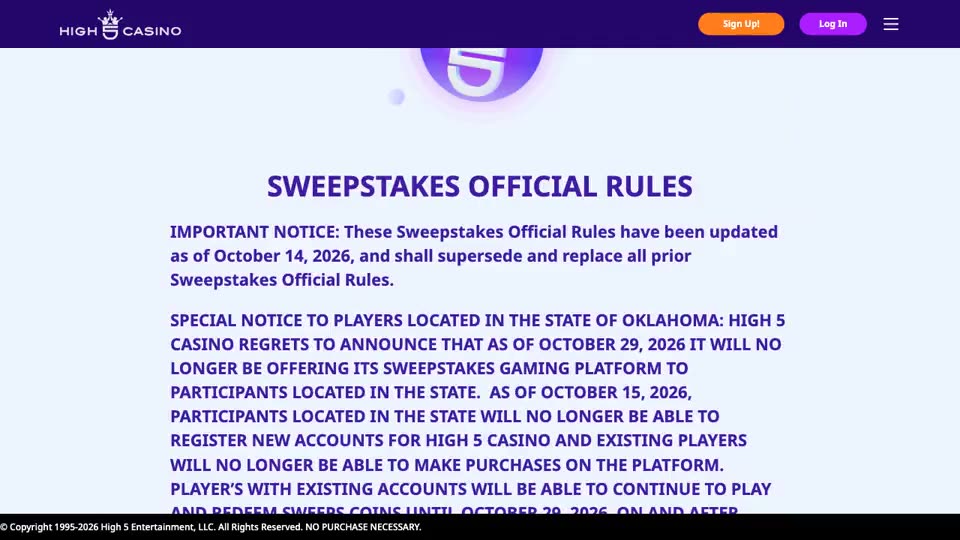
High 5’s public Sweepstakes Official Rules, updated October 14, 2026: the important-notice banner, the special notice to players located in Oklahoma, the “no purchase necessary” statement and the opening paragraph that incorporates the terms of use.
The second record is a settlement. New York’s Attorney General and VGW’s companies resolved an investigation with an Assurance of Discontinuance that sets out money, a redemption window and the respondents’ position on the findings:
13. Respondents neither admit nor deny the NYAG’s Findings, paragraphs 1-11 above. … 18. For one year following the effective date of this Agreement, Respondents shall enable New York Consumers who did not previously receive a notification from VGW, as described above in Paragraph 10, to submit a request to redeem sweeps coins that were in the Consumer’s account with a Respondent as of June 2, 2025. … 19. Respondents shall pay to the State of New York eight million dollars ($8,000,000) in disgorgement, restitution, penalties, and costs.
A settlement, not a ruling. It binds the respondents only. It records a redemption window of one year for consumers who had coins on June 2, 2025, and a payment of $8 million.
The footprint cost is also visible in the operators’ own rules. Chumba’s definition of permitted territory excludes sixteen states by name:
Permitted Territories means the United States (other than the states of California, Connecticut, Delaware, Idaho, Indiana, Louisiana, Maine, Michigan, Mississippi, Montana, Nevada, New Jersey, New York, Tennessee, Washington, and West Virginia)
The state map is a design input, and it changes by rules revision: High 5’s notice above is an example.
The stack, and what two statutes say about each layer
The competitive map below follows the layers the record shows. California and New York have both written statutes that name the supplier layers, so the statute text is the cleanest statement of which layers the law reaches in those two states. California’s prohibition, added by AB 831, reads:
337o. (a) It is unlawful for any person or entity to operate, conduct, or offer an online sweepstakes game in this state. (b) It is unlawful for any entity, financial institution, payment processor, geolocation provider, gaming content supplier, platform provider, or media affiliate to knowingly and willfully support directly or indirectly the operation, conduct, or promotion of an online sweepstakes game within this state.
California adds a knowledge element for the support layers. The statute defines the game by a coin that is purchased or received as a bonus and a second coin that can be exchanged for a prize or cash; the sweepstakes series quotes the definitions.
New York’s Racing, Pari-Mutuel Wagering and Breeding Law section 912, added by S5935-A, names the same layers and sets penalties:
(b) It shall be unlawful for any applicant, licensed entity, financial institution, payment processor, geolocation provider, gaming content supplier, platform provider, or media affiliate to support the opera- tion, conduct, or promotion of online sweepstakes games within the state of New York. 3. Penalties. (a) Any applicant, licensed entity, gaming employee, key employee, individual investor or investment firm, board member, or any other person or entity found in violation of this section shall be subject to a fine of not less than ten thousand dollars and not more than one hundred thousand dollars for each violation
New York’s clause 2(b) has no knowledge element in the text. The text is as printed on the Assembly page, whose line breaks hyphenate “operation”.
| Layer | Who buys it | How the record says it is paid | What California § 337o and New York § 912 say about it | Public examples in the records read |
|---|---|---|---|---|
| Operator and brand | Players, who pay for Gold Coin packs | Pack prices; Sweeps Coins come as a bonus with a purchase (Chumba cl. 3.2(a)); revenue and cost figures are not stated by any operator in a filing read | Both statutes prohibit operating, conducting or offering the game (CA (a); NY § 912(2)(a)) | Chumba Casino and High 5 Casino, through their published rules |
| Game content | Operators | Revenue sharing, in the form one listed company describes for its regulated casino (Meridian 10-K); rates not stated | Both statutes name “gaming content supplier” | Expanse Studios: five integrations into U.S. sweepstakes casinos (Golden Matrix 8-K, May 2025) |
| Platform and certified game technology | Operators | Not stated | Both statutes name “platform provider” | Hyperscale’s BNC: third-party certified providers for random number generation and sweepstakes mechanics (FY2024 10-K) |
| Payments and banking | Operators | Not stated; the 30% app-store fee and the move to direct payment are in PLAYSTUDIOS’s filings | Both statutes name “financial institution” and “payment processor” | Payment-system companies are defendants in Florida’s complaint (allegations) |
| Geolocation and eligibility | Operators | Not stated | Both statutes name “geolocation provider” | Operators’ state exclusion lists (Chumba cl. 1.1(b)) and High 5’s state notice show the need; no vendor is named in the records read |
| Marketing, media and affiliates | Operators | Not stated; Triller describes a partner-led model with no split | Both statutes name “media affiliate” | Triller Sweeps (shareholder presentation, June 2026) |
| CRM, loyalty and retention | Operators and social-casino developers | PLAYSTUDIOS’s playAWARDS division reported net revenue of $1,008 thousand for 2025 against $62 thousand for 2024 | Not named in either statute | playAWARDS (PLAYSTUDIOS 10-K) |
| Social-only products with no redemption (benchmark) | Players | PLAYSTUDIOS net revenue $234.1 million for 2025; 30% platform fees on store sales | Both statutes define the sweepstakes game by a redeemable second coin; this layer has no such coin | PLAYSTUDIOS, Playtika, Light & Wonder |
The last two rows come from PLAYSTUDIOS’s annual report. The division’s revenue is the filing’s own figure:
Virtual currency revenue $ 986 $ 54 $ 932 1725.9 % Other revenue 22 8 14 175.0 % Net revenue $ 1,008 $ 62 $ 946 1525.8 %
The columns are 2025, 2024, change and percentage change. The division is small and its growth rate is from a small base.
PLAYSTUDIOS also states, in the same annual report, that it runs sweepstakes mechanics itself. The statement is the company’s, and shows an incumbent operating in the category:
We operate games that incorporate sweepstakes-based promotional mechanics, including casino-style gameplay paired with promotional sweepstakes structures.
What the record shows about room for a new company
Everything below is a statement about the record, not a forecast, and each carries the condition it depends on.
- Direct payment is a stated priority in a related business. PLAYSTUDIOS’s direct-to-consumer virtual-currency revenue rose from $6.7 million to $14.7 million between the June 2025 and June 2026 quarters while its third-party-platform revenue fell. A sweepstakes casino is a web product that sells to the player directly, so the payments layer is part of its core cost. The record states no processing rate for any sweepstakes operator, and the payment dependency is one the filings call a risk.
- Content suppliers are selling into this segment. A listed company says a studio made five integrations into U.S. sweepstakes casinos in a quarter. In California and New York the statutes name the content layer, so a studio’s state map matters; elsewhere the exposure depends on the other states’ law, which the sweepstakes series covers.
- The state map changes the product. Chumba excludes sixteen states by name, High 5 gave Oklahoma players a fourteen-day wind-down in October 2026, and the New York settlement set a one-year redemption window. Geolocation, eligibility and notice handling are named in both statutes and are standing requirements of any operator that keeps a state list.
- A partner-led structure is described in a public filing. Triller describes contributing audience and brand while a partner runs operations and compliance. The record gives no revenue figure for it, and the model puts the operating and legal weight on the partner.
- Retention tooling has a public benchmark. PLAYSTUDIOS’s playAWARDS division is small, and the filing treats loyalty as a differentiator. Neither statute names this layer.
- The record also shows exits. Hyperscale Data’s fiscal 2025 report says its subsidiary has discontinued its sweepstakes gaming operations and is developing a prediction-markets platform. A builder who plans around a business model has to plan for the possibility that the model changes, whether by the company’s choice or by law.
The Platform represents a fundamental repositioning of BNC’s business. BNC has discontinued its prior sweepstakes gaming operations and is currently developing the BitNile.com platform as a predictions market.
What a builder does with this
- Decide the layer before the product. The table says which layers the two statutes name. A business in one of the named layers is a business the statutes address in California and New York, whatever the contract with its customer says.
- Build the revenue model from the rules, not from the lobby. Read the operator-style rules you plan to follow: how a redeemable coin is obtained, what it is worth, how many plays before redemption, what the minimum is and what the caps are. Then write the model with your own data for return to player, redemption rate and payment costs, because none of the sources read states them.
- Price distribution before design. The 30% store fee and the direct-payment shift in PLAYSTUDIOS’s filings are the only published payment figures in the records read. Treat payments as the first cost line and get your processor’s terms in writing before the model is final.
- Treat the state map as a feature. Keep an excluded-states list, a state-notice process and a wind-down procedure (stop purchases, a redemption window, a closing date), and version the rules. High 5’s two-step notice and the New York window are published examples of both.
- Choose your counterparties with the statutes in hand. California’s prohibition on support reaches suppliers who “knowingly and willfully” support the game, and New York’s text has no knowledge element. A supplier contract should say which states the supplier’s product is licensed for.
- Where the record is silent, ask. No source read prices KYC, geolocation, content royalties or affiliate commissions for this segment. Collect quotes from the vendors you would use and treat them as your inputs, not as industry facts.
- Keep the benchmark honest. PLAYSTUDIOS is a traditional social casino developer with no cash redemption. Use its figures as a cost and distribution benchmark for the no-redemption layer, and not as a forecast of any dual-currency operator’s results.
- Read the neighbours before building. The sweepstakes series covers the legal test, the enforcement routes and the checklist; the contests series covers the promotion and skill-contest lines; the payments series covers money transmission and processor diligence.