Sweepstakes casinos · Brief · 6 min read
Sweepstakes casinos: does skill change anything in a Gold Coin game?
Three ways statutes and courts measure chance, one state each, then what the new sweepstakes-casino statutes do with a game that has skill in it, and how one operator’s own rules draw a state line by game format.
A sweepstakes casino sells a coin with no cash value and gives away a second coin that can be redeemed. Some builders ask whether the game the redeemable coin is played on can be made a game of skill, and whether that changes the analysis. The answer depends on the text in front of you, because the texts measure chance in three different ways and the newest statutes do not measure it at all. This brief sets out one example of each.
Three measures of chance, one example each
New Jersey’s definition of a contest of chance asks whether chance has a material role, and says in terms that skill alongside it does not take the game outside:
a. "Contest of chance" means any contest, game, pool, gaming scheme, or gaming device in which the outcome depends in a material degree upon an element of chance, notwithstanding that skill of the contestants or some other persons may also be a factor therein. … f. "Slot machine" means any mechanical, electrical, or other device, contrivance, or machine which, upon insertion of a coin, token, or similar object therein, or upon payment of any consideration whatsoever, is available to play or operate, the play or operation of which, whether by reason of the skill of the operator or application of the element of chance, or both, may deliver or entitle the person playing or operating the machine to receive cash or tokens to be exchanged for cash
In New Jersey’s text, skill and chance can coexist in a covered game. The slot-machine definition is satisfied by skill, chance or both.
Montana’s gambling definition reaches any gain contingent on chance at all:
(14) (a) "Gambling" or "gambling activity" means risking any money, credit, deposit, check, property, or other thing of value for a gain that is contingent in whole or in part upon lot, chance, or the operation of a gambling device or gambling enterprise.
A measure of “in whole or in part” leaves no room for a game in which chance plays any role. Montana’s definition has a separate carve-out for a no-currency online casino, which the previous brief quotes.
North Carolina’s sweepstakes statute turns on chance too, and its courts weigh it with a predominant-factor test. The statute defines a sweepstakes by chance “with or without payment of any consideration”, and the Court of Appeals set out the test in a 2023 case about an electronic fish-shooting game in a sweepstakes setting:
is defined as “any game, advertising scheme or plan, or other promotion, which, with or without payment of any consideration, a person may enter to win or become eligible to receive any prize, the determination of which is based upon chance.” … In determining whether a game is one of chance or one of skill, the court re-affirmed the use of a predominant- factor test. Id. This test asks if chance or skill “ ‘is the dominating element that determines the result of the game, to be found from the facts of each kind of game,’ or, ‘to speak alternatively, whether . . . the element of chance is present in such a manner as to thwart the exercise of skill or judgment.’ ”
The case concerns physical electronic sweepstakes machines, not online coin casinos. It is quoted because it applies a skill-versus-chance test to a sweepstakes statute.
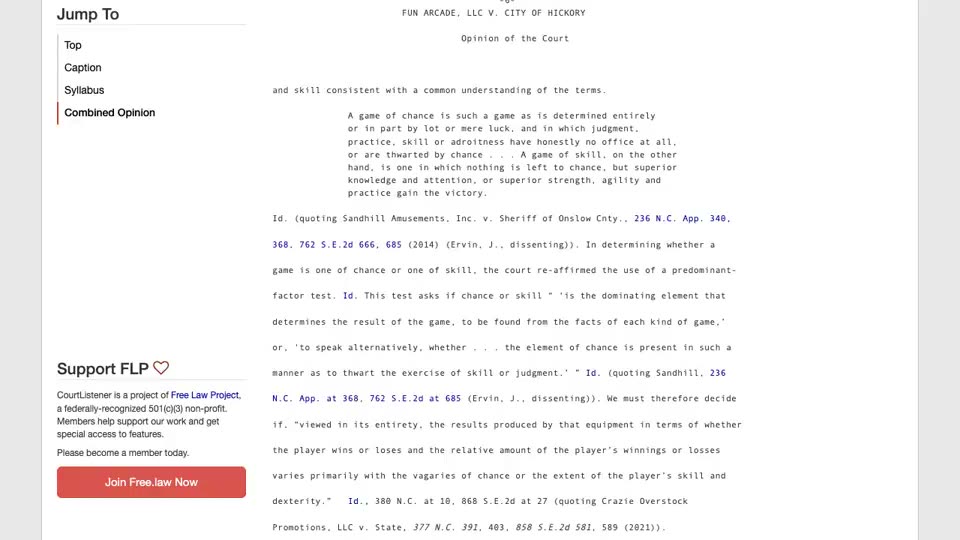
CourtListener’s public page for the North Carolina Court of Appeals opinion, scrolled through the passage defining games of chance and skill and the predominant-factor test, then the court’s application to the fish game.
The court then applied the test and said how skill is weighed when chance sets the stakes:
It concluded, even if a player were to become more skilled, “chance would always predominate because, when chance determines the relative winnings for which a player is able to play, chance ‘can override or thwart the exercise of skill.’ ” … Though players must have some measure of dexterity to use the joystick, a player cannot know beforehand how many hits are necessary to destroy fish and, thus, cannot strategically optimize a favorable return on credits.
The quotation from Gift Surplus v. State is the court’s. The same opinion records the earlier holdings that bowling is predominantly a game of skill and poker is predominantly a game of chance.
What the new statutes do with skill
California’s and New York’s sweepstakes-casino texts define the game by its coin model and a list of simulated games, and the list names poker, the standard example of a game with skill in it. California’s section 337o(c)(3)(C):
(B) Utilizes a dual-currency system of payment that allows a person to play or participate with direct consideration or indirect consideration, and for which the person playing or participating may become eligible for a prize, award, cash, or cash equivalents or a chance to win a prize, award, cash, or cash equivalents. (C) Simulates gambling, which, for purposes of this section, includes, but is not limited to, any of the following: (i) Slot machines. (ii) Video poker. (iii) Table games, including, but not limited to, blackjack, roulette, craps, and poker.
The conditions are the coin model, a gambling simulation and a cash or equivalent award. A skill element does not appear among them.
(b) "Table games" shall include, but not be limited to, blackjack, roulette, craps, and poker.
Where a statute is written around the coin model and a list of games, the chance prong is not the question the text asks. Where it is written around chance, as in North Carolina and Montana, skill is weighed by the court’s test or does not enter at all. New Jersey’s sweepstakes provision, quoted in the previous brief, is written around payment and a list of games, and its definition of a contest of chance, above, treats skill as compatible with a covered game.
How one operator’s rules draw a line by game format
An operator’s own rules show where it treats a skill-and-chance game differently. Global Poker, a peer-to-peer poker site, runs the same two-coin structure with its own threshold, and its permitted-territory definition carries an exception for one format in one state:
SWEEPS COINS ARE SUBJECT TO A MINIMUM PRIZE REDEMPTION THRESHOLD OF $US50. … (b) Permitted Territories means the United States (other than the states of California, Connecticut, Delaware, Idaho, Indiana (except for peer-to-peer poker), Louisiana, Maine, Michigan, Mississippi, Montana, Nevada, New Jersey, New York, Tennessee, Washington and West Virginia)
The rules do not say why the exception exists and do not describe poker as a game of skill.

Global Poker, a VGW brand, explains its paid currency: free to play with 5,000 Gold Coins at sign-up, more Gold Coins sold in packages of different sizes, and Gold Coins that have no value and cannot be redeemed for prizes.
What a builder does with this
- Ask which measure the state uses before asking how skillful the game is. New Jersey’s text treats skill as compatible with chance; Montana’s reaches any chance; North Carolina’s courts weigh which factor predominates.
- Where a court weighs skill, expect the question to turn on how the game actually plays. The North Carolina court looked at what a player can know and control, and held that when chance sets the stakes, added skill does not change the result.
- Where a statute defines the game by its coin model and a list of simulated games, skill is not an element in the text. California’s and New York’s lists name poker.
- Treat a format-based state line as a design choice with its own conditions: Global Poker’s rules carry one for peer-to-peer poker in Indiana, and say nothing about why.
- Do not read skill as an answer to the consideration question. An alternate method of entry is a different element from the one skill addresses, and the statutes above each state their own elements.