Prediction markets · Brief · 7 min read
Prediction markets: responsible gaming when an event contract looks like a bet
What a state sports-betting rule requires of a licensed sportsbook, what an exchange and a broker publish for their own customers, what the industry codes ask, and a checklist for a startup that wants to meet both.
A prediction market with sports contracts can look to a customer like a sportsbook, and a state can look at it the same way. This brief sets out what one state requires of a licensed sportsbook for its customers’ protection, what an exchange and a broker publish for theirs, and what two industry codes ask of operators. It ends with a checklist for a startup that wants to meet both sets of expectations. It does not say any platform’s tools are or are not adequate.
What one state requires of a licensed sportsbook
Ohio’s rule on sports gaming accounts requires a sportsbook to give patrons a way to set limits on deposits, wagers and time, from registration on, and says how the limits behave:
Provide patrons with an easy and obvious method, immediately upon initial account registration and at all times through the sports gaming proprietor's website or application, to impose limitations for betting parameters including, but not limited to, deposits, wagers, and time-based limitations. … (c) Once established by a patron and implemented by the sports gaming system, it must only be possible to reduce the severity of self-imposed limitations upon the expiration of the self-imposed period; and (d) An option must be available for patrons to set automatically renewing self-imposed limits
Ohio’s rule applies to a licensed sports gaming proprietor. It is quoted to show what a state requires of a sportsbook, and the brief does not say it applies to an exchange.
The same rule requires an age acknowledgement and resources at account opening and closing:
(b) A patron must acknowledge that the legal age for sports gaming is twenty-one years of age, and that they are prohibited from allowing any other person to access or use their sports gaming account. The sports gaming proprietor must document this acknowledgment; and (c) A patron must be notified of available responsible gaming resources; … Upon account closure, the patron must be notified of available responsible gaming resources, including a helpline number
Ohio’s advertising rule requires a problem-gambling message and a helpline in each advertisement, and bars depictions of anyone under 21:
(3) Clearly and conspicuously include messages designed to prevent problem gambling and provide information about how to access resources related to problem gambling, including one of the following: (a) The national council on problem gambling's twenty-four hour confidential helpline; … (B) Sports gaming advertisements must not: (1) Depict any individual under the age of twenty-one, except live footage or images of athletes in sporting events on which sports gaming is permitted. … (2) Target individuals under the age of twenty-one, other individuals who are ineligible to participate in sports gaming, individuals with gambling problems, or other vulnerable individuals;
Kentucky’s Attorney General has alleged, in lawsuits filed in June 2026, that prediction-market platforms and brokers fall short of a similar requirement under Kentucky law:
The prediction market lawsuits also allege Polymarket and Kalshi and its affiliated entities, Coinbase, Robinhood and Webull offer users few or no resources to identify or seek help for a gambling problem, which is mandated under Kentucky law.
These are allegations in lawsuits. No court has decided them, and the Kentucky requirement was not read for this brief.
What an exchange publishes
Kalshi’s public page on responsible trading lists six categories of tools and says where to find them:
Trading breaks Take a temporary pause from trading when you need to step back. … Self-exclusions Exclude yourself from the platform for a specified period. For ecosystem-wide self exclusion, visit SelfExclude.io … Deposit limits Set a maximum monthly deposit amount to manage your overall exposure.
The company’s help article on self-exclusion says what the exclusion does not cover:
Please note that Voluntary Self-Exclusion does not limit a trader's ability to access Kalshi products via a Futures Commission Merchant. It is ultimately the trader's responsibility not to trade during this time.
A customer can reach the same contracts through a registered broker, so an exchange-level exclusion and a broker-level exclusion are separate tools.

Kalshi’s public “Responsible trading tools” page: the six available resources (trading breaks, self-exclusions, deposit limits, mental health support, educational guides, account security), then where to find the settings in the app and on the web.
What a broker publishes
Robinhood’s help article on opting out has two tools at different levels, a setting that hides sports markets and an account-level self-exclusion, and a helpline reference:
You have several options to limit or stop your event contract trading, from disabling sports prediction markets in the app to requesting a full self-exclusion. … Self-exclusion is a formal, account-level opt-out from all event contract trading. It's different from using the in-app toggle to disable sports prediction markets. … If you're concerned about your relationship with event contract trading, support is available. You can reach the National Council on Problem Gambling helpline at 1-800-522-4700.
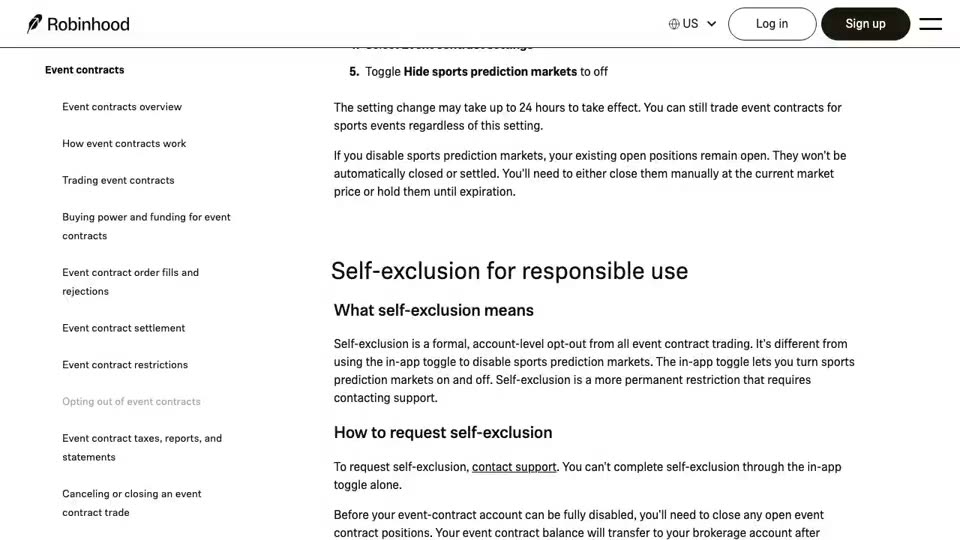
Robinhood’s public help page on opting out of event contracts, scrolled through “Self-exclusion for responsible use”: what self-exclusion means, how to request it through support, what happens after the request, and the National Council on Problem Gambling helpline reference.
What the industry codes ask
The American Gaming Association’s marketing code for sports wagering is a voluntary code. It asks for an age floor of 21, a responsible-gaming message with a helpline, and no “risk free” language:
No sports betting message should be designed to appeal primarily to those below 21 – the prevailing legal age for sports wagering. … Each message will contain a conspicuous responsible gaming message along with a toll-free helpline number, where practical. … No message should suggest engaging in sports wagering is without risk or utilize “risk free” language.
A trade association’s code for its members. The version read is dated March 28, 2023.
The National Council on Problem Gambling’s standards, also voluntary, describe limit tools and an age recommendation for internet gambling in general:
A minimum age of 21 is strongly recommended to access any play, whether free or paid. … Customers can set daily, weekly, or monthly limits on the size of deposits. … Customers can set daily, weekly, or monthly limits on the amount of time spent on the platform.
The standards are a template of best practices for operators, regulators and vendors. They are not law.
A checklist for a startup that wants to meet both
- Limits at signup and at any time: deposit, wager and time limits, easy to find from the first screen, that can be tightened at once and loosened only when the period ends (Ohio’s rule).
- Age and acknowledgement at account creation: an age floor of 21 where the product is sold as a sports contract, with a documented acknowledgement (Ohio’s rule, the AGA code and the NCPG standards).
- A resources message at opening, in each advertisement and at closing, with a helpline (Ohio’s rules, the AGA code, and the exchange and broker pages above).
- Self-exclusion at the level the customer needs: an exchange-level tool and a broker-level tool are separate, and Kalshi’s own help article says the first does not cover access through a broker.
- A way to hide or pause sports markets without closing the account, as Robinhood’s setting does, and a formal self-exclusion for those who want it.
- Advertising rules written down: no depictions of anyone under 21, no targeting of vulnerable people, no “risk free” language (Ohio’s advertising rule and the AGA code).
- A record that each tool exists and works. The Kentucky release shows what a state alleges when it finds “few or no resources”, and the allegation has not been decided.
What a builder does with this
- Build the tools before the launch. The Ohio rule asks for limits at registration, and an exchange’s or broker’s page is a public list of what a customer can see.
- Decide whether you are an exchange, a broker or a front end, and which tool each one has to offer. A front end that sits over a broker inherits the broker’s tools and the broker’s gap.
- Read the state’s requirements for your product and the voluntary codes side by side. The codes are not law, and the states’ rules differ; this brief read one state.
- Keep the evidence: screenshots of the tools, the limits logic, the helpline text and the ad review. A regulator’s question about resources is answered with a record.
- Re-read the sources before launch. The codes and the platform pages change, and the AGA code read here is dated 2023.