Prediction markets · Brief · 7 min read
Prediction markets: passive software, introducing broker or advisor — the three paths compared
Side by side, from the staff letter, the Commission’s rules and NFA’s own pages: what each path allows a front end to do, what it asks for before launch and what the published figures are.
A startup that puts a front end on regulated event contracts is choosing among three structures, and the choice follows the product’s verbs: whether it only displays and transmits, whether it also solicits and accepts orders as a registered firm, or whether it gives advice. The deep dive on the Phantom letter works through each path. This brief puts them side by side, and under each cell of the table gives the primary text it rests on.
The comparison
| The question | Passive software (Staff Letter 26-25) | Introducing broker | Commodity trading advisor |
|---|---|---|---|
| What the path covers | Front-end software that shows data and positions and sends the user’s orders directly to a registrant, with marketing and soliciting of users to named registrants | Soliciting or accepting orders for futures, options or swaps, without accepting customer funds | Advising others, for compensation, on the value of trading or whether to trade |
| What you file or sign | A notice to the Division and a written undertaking with each registrant | NFA Form 7-R and a membership application; Form 8-R, fingerprints and proficiency for each principal and associated person | NFA Form 7-R and Form 8-R, unless an exemption applies |
| Published fees | None stated in the letter | $200 application fee; $750 dues; $85 for each principal or associated person not already registered | $200 application fee; $750 dues; $85 for each principal or associated person not already registered |
| Capital | None stated; provider never holds user assets | $45,000 adjusted net capital, or a guarantee agreement | No figure on the NFA page read |
| Time to start | Not stated in the letter | Not stated on the NFA pages read | Not stated on the NFA pages read |
| Who can change the terms | Division staff, at its discretion; the position runs until a Commission rulemaking or guidance | The Commission and NFA, by rule | The Commission and NFA, by rule |
Path one: the text behind the cell
The first column is a staff position, so its terms are the letter’s. The activities it covers and the line it draws are in two passages:
The PSP will develop and distribute front-end interface software for Users to review market data and aggregate position information, view information about product offerings, and submit orders for Commission-regulated derivative products directly to Registrants, including event contracts, perpetual contracts, and other Commission-regulated derivatives. … At no point would the PSP hold, control, or take into custody User assets, generate express “buy” or “sell” signals, or exercise discretion with respect to the routing or execution of User orders.
The PSP and each of its Registrants execute in writing an undertaking by which they each agree to be jointly and severally liable for any violations of the Act or Commission regulations by the PSP or any of its personnel when the PSP or its personnel engage in the Covered Activities with or on behalf of such Registrant. … This letter and the no-action position taken herein are not binding on the Commission. … Finally, as with all staff letters, the Division retains the authority to condition further, modify, suspend, terminate, or otherwise restrict the terms of the position taken herein, in its discretion.
The undertaking makes the registrant a party to the product, and the closing paragraph is why the table’s last row names the Division as the party that can change the terms.

A wallet front end for event contracts: Phantom’s public Prediction Markets page shows in-app screens with a basketball game priced in percentages and a “Make your prediction” control, then opens the FAQ answer stating that its markets are powered by Kalshi via DFlow and that users do not open a Kalshi account.
Path two: the text behind the cell
The statute makes it unlawful to be an introducing broker without registering, and NFA’s page lists what registration takes and what it charges:
(g) Introducing broker registration requirements It shall be unlawful for any person to be an introducing broker unless such person shall have registered under this chapter with the Commission as an introducing broker and such registration shall not have expired nor been suspended nor revoked.
To register as an IB and become an NFA Member: Designate a Security Manager in order to obtain secure access to NFA's Online Registration System (ORS) Complete online Form 7-R Complete online NFA membership application Satisfy compliance requirements for IB applicants Complete online Member Questionnaire Pay a non-refundable application fee of $200 Pay non-refundable IB membership dues … Pay a non-refundable application fee of $85 for each principal and AP
The Commission’s capital rule gives the introducing-broker floor and the guarantee alternative the table cites:
(iii) Except as provided in paragraph (a)(2) of this section, each person registered as an introducing broker must maintain adjusted net capital equal to or in excess of the greatest of: (A) $45,000; (B) The amount of adjusted net capital required by a registered futures association of which it is a member; … (ii) The minimum requirements of paragraph (a)(1)(iii) of this section shall not be applicable to an introducing broker which elects to meet the alternative adjusted net capital requirement for introducing brokers by operation pursuant to a guarantee agreement which meets the requirements set forth in § 1.10(j).
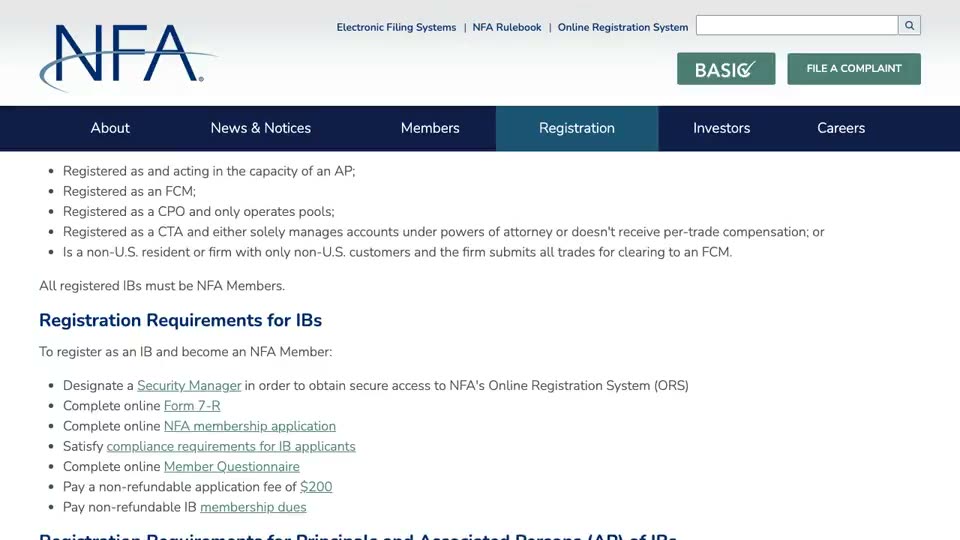
NFA’s public introducing-broker page: who is exempt from registering, then the steps to register as an IB and join NFA, with the $200 application fee and the dues line, then the separate steps and $85 fee for each principal and associated person.
Path three: the text behind the cell
The advisor path answers a different question from the first two, and Letter 26-25 does not address it: the letter covers introducing-broker and associated-person registration only. The statute’s registration rule, with its small-adviser exemption, and the Commission’s exemption for advice that is not tailored are the primary text:
It shall be unlawful for any commodity trading advisor or commodity pool operator, unless registered under this chapter, to make use of the mails or any means or instrumentality of interstate commerce in connection with his business as such commodity trading advisor or commodity pool operator: Provided, That the provisions of this section shall not apply to any commodity trading advisor who, during the course of the preceding twelve months, has not furnished commodity trading advice to more than fifteen persons and who does not hold himself out generally to the public as a commodity trading advisor.
(9) It does not engage in any of the following activities: (i) Directing client accounts; or (ii) Providing commodity trading advice based on, or tailored to, the commodity interest or cash market positions or other circumstances or characteristics of particular clients
This is an exemption from registration, not from the definition of an advisor.
Pay a non-refundable application fee of $200 … Pay non-refundable CTA membership dues
NFA’s dues table puts the number on the dues line for introducing brokers and advisors alike:
Introducing Broker $750 Introducing Broker Forex Firm $2,500 Introducing Broker Swaps Firm $2,500 … Commodity Trading Advisor $750 Commodity Trading Advisor Forex Firm $2,500 Commodity Trading Advisor Swaps Firm $2,500
The page also has “swaps firm” rows at $2,500 for each category. Which row applies depends on whether the business includes swaps.
What a provider says about itself
Whichever path a product takes, its terms say what it is. A software provider’s public terms are where the claim is made to users. Phantom’s general Terms of Use, last updated March 17, 2026, state the wallet’s role in these words:
Phantom is a developer and supplier of software. Phantom is not a broker, nor is it a dealer or arranger, nor does it operate a Digital Asset exchange platform or offer trade execution or clearing services and, therefore, has no oversight, involvement, or control concerning the transactions you choose to conduct via the Functionality. … Phantom is not acting as an investment manager, adviser, arranger, introducer, broker, dealer, virtual asset service provider or commodity trading adviser to any person or entity.
These are the wallet’s general terms, which cover its digital-asset functionality. They are quoted for how a software provider states its role, not as terms written for prediction markets, and the brief draws no conclusion about any product under the letter.
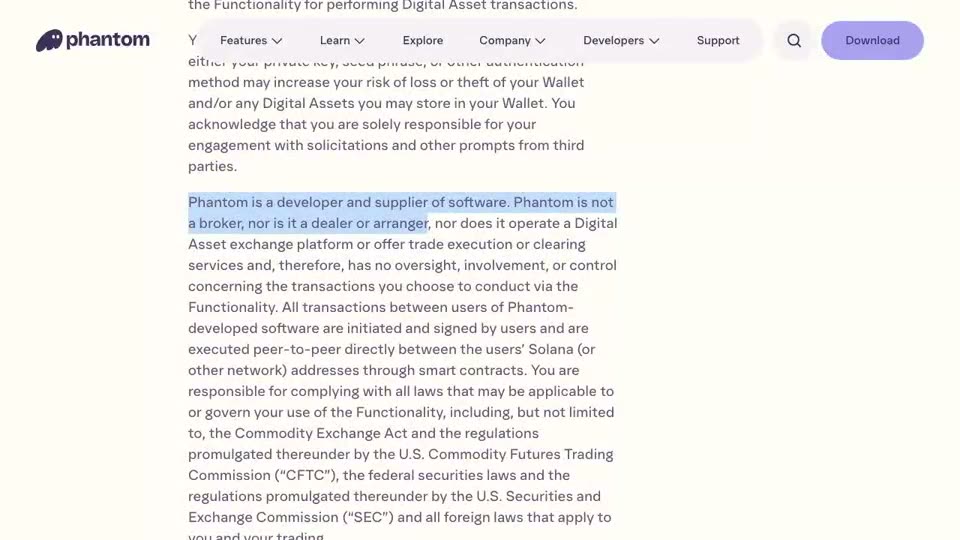
Phantom’s public Terms of Use, dated March 17, 2026: the custody, broker and adviser passages, highlighted in turn.
What a builder does with this
- Start from the product’s verbs. Display and transmit fit the first column; soliciting and accepting orders as a registered firm is the second; advice is the third and can sit alongside either of the others.
- Read the table’s blanks as work. The time to start is not stated for any path, and the letter states no fee. Plan the launch date from your own registrant and your own counsel, not from a published figure.
- Count fixed costs from the published lines only: $200 and $750 for the firm, $85 for each person not already registered, and capital of $45,000 or a guarantee for an introducing broker. Exams, fingerprinting and any guarantor are separate and the pages read do not price them.
- Keep the first release inside one column. A front end that adds recommendations or custody moves out of the first column’s description, and the deep dive sets out the designs that do.
- Treat a staff position as a position. It runs until the Commission acts and the Division can change it, so a product built on it should be able to move to a registered path.