Prediction markets · Brief · 7 min read
Prediction markets: insider trading and integrity on sports event contracts
Who may not trade a sports event contract, who sets that rule, and who enforces it: the federal provisions, the exchanges’ own rules, the leagues’ agreements with the Commission, the two published disciplinary cases and one state’s statute for comparison.
A sports event contract can be traded by someone who knows how the game will end, can influence it, or works for the body that publishes the result. Four sets of documents say who may not trade it and who enforces that: the federal provisions, the exchanges’ own rules, the leagues’ agreements with the Commission, and, for comparison, a state sports-betting statute. This brief reads each, and states where the record has gaps.
The federal provisions
Commission staff’s March 2026 advisory on prediction markets states the anti-fraud rule and places insider trading inside it:
Commission Regulation 180.1 makes it unlawful for any person to employ any device, scheme, or artifice to defraud or attempt to defraud any person or manipulate the price of any contract listed on a DCM. … Without limitation, these practices include misappropriation of confidential information in breach of a preexisting duty of trust and confidence to the source of the information (commonly known as “insider trading”), pursuant to CEA section 6(c)(1) and Commission Regulations 180.1(a)(1) and (3).
The rule reaches misappropriation of confidential information in breach of a duty. It is not a general ban on trading with an informational advantage.
The same letter tells exchanges what to look to for sports contracts, and recommends cooperation with leagues:
DCMs are also encouraged to look to, among other items, any league integrity standards or guidance around markets, contracts, and restricted or insider participants lists, in order to protect against manipulation and insider trading, … DMO staff also recommends that DCMs cooperate with any league-run investigations into potential manipulation or insider trading investigations.
A staff advisory is guidance, not a rule. The letter says DCMs are “encouraged” and that staff “recommends”.
The Enforcement Division’s advisory in February made clear that an exchange’s own enforcement does not displace the Commission’s:
While Kalshi’s internal enforcement program handled these matters, under the Act, the Commission has full authority to police illegal trading practices occurring on any DCM, including those described above related to prediction markets.
The exchanges’ own rules
The exchanges’ rules go further than the federal rule. Kalshi’s rulebook bars two groups from trading a contract: people with inside information or influence, and people who are decision makers:
(y) If a Trader is an Insider that has access to material non-public information that is the subject of an Underlying of any Contract or that has the ability to exert any influence on the subject of an Underlying of any Contract, that Trader is prohibited from attempting to enter into any trade or entering into any trade, either directly or indirectly, on the market in such Contracts. … (z) If a Trader is a decision maker, either directly or indirectly, or has any influence, either directly or indirectly, no matter the scale and importance of the influence, on the outcome of the Underlying (event) of any Contract, that Trader is prohibited from attempting to enter into any trade or entering into any trade, either directly or indirectly, on the market in such Contracts.
Rule 5.17(y) bars insiders and anyone with influence, and (z) bars anyone with any influence on the outcome, whether or not the person holds confidential information.
Polymarket US’s rulebook defines a restriction tied to the source of the settlement number:
“Source Prohibition” means the trading restrictions applicable to any Person who (a) has access to material non-public information from a Source designated for any Contract, or (b) is otherwise in a position to influence the determination or declaration of the Expiration Value
A broker that offers contracts from several exchanges points customers to each exchange’s rules. Robinhood’s help page says so:
In addition to the general prohibition against trading on material nonpublic information, each exchange will institute additional prohibitions for trading the contract. The individuals specified in Kalshi’s Appendix B will also be prohibited from trading.
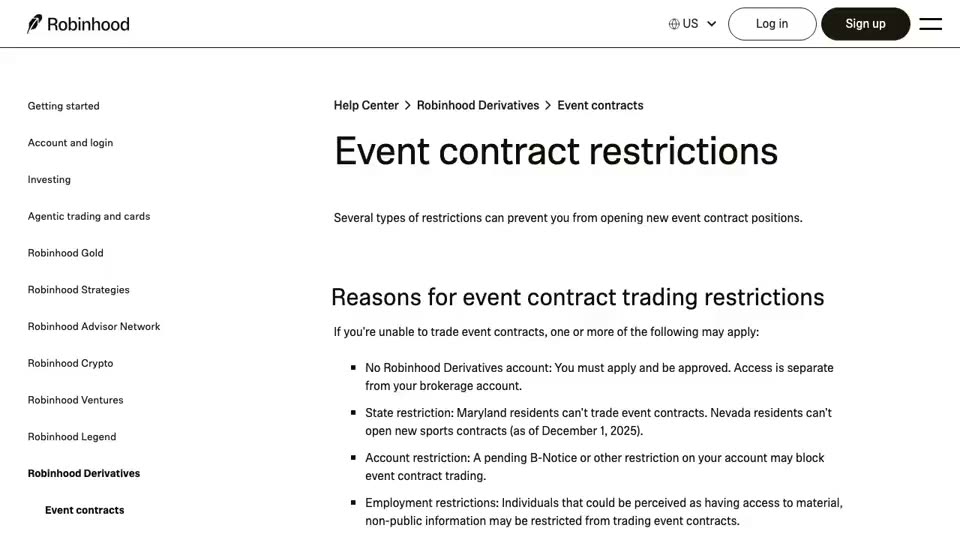
Robinhood’s public help page on event contract restrictions, scrolled to “Prohibited individuals”, which refers to each exchange’s prohibitions and to Kalshi’s Appendix B, then the position-closing-only restriction and the “stricter area” error.
The leagues and the screening vendors
Kalshi’s market-integrity page says how it screens sports participants, using lists that leagues provide to a vendor:
Kalshi works with third party vendors to identify and block professional and NCAA athletes, coaches, trainers, and other individuals associated with sports from trading on sports contracts that are related to the sport in which they work or play. These vendors include IC360, the leading integrity partner for professional sports leagues and the NCAA. … Professional and collegiate sports leagues provide IC360 lists of athletes, coaches, staff, and other individuals connected to teams. IC360 maintains these lists in a secure database and coordinates with Kalshi to identify any potential matches to these lists at onboarding.
This is the operator’s description of its own process. The page says the screen is applied at onboarding.
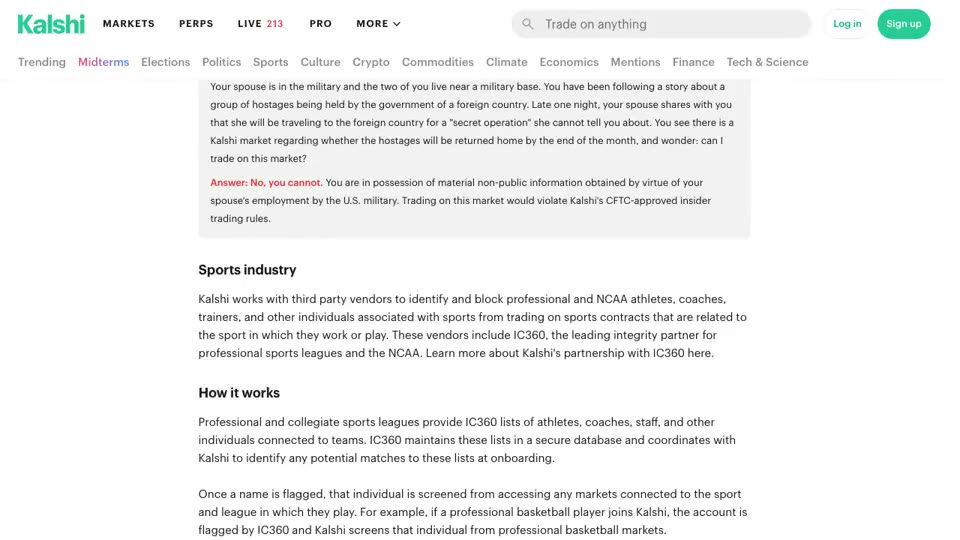
Kalshi’s public market-integrity page, scrolled through its “Sports industry” section: the vendors that screen athletes, coaches and officials, how league-provided lists are matched at onboarding, who is screened, the other trading the rules prohibit, and what else is monitored.
The leagues have also signed memoranda with the Commission. The MLB memorandum states what it is and what it is not:
1. This MOU is a statement of intent to discuss, cooperate, and exchange information concerning issues of common interest, such as the integrity of professional baseball and the event contract markets related thereto
The memorandum also says it does not supersede any applicable law and creates no legally binding obligations.
the CFTC and NHL have solidified the intent to share information and coordinate to protect the integrity of both professional hockey and related event contracts offered on CFTC-regulated exchanges.
What has been published as enforcement
The Commission’s February release describes two disciplinary cases that an exchange handled. Neither involves a sports contract. In the first, the release says the trader was a political candidate trading on his own candidacy; in the second, a YouTube channel’s editor trading contracts on that channel:
Kalshi imposed a $2,246.36 financial penalty (disgorgement of $246.36 related to the improper trading activity, plus a $2,000.00 penalty) and a 5-year suspension from direct or indirect access to the exchange. … imposed a $20,397.58 financial penalty (disgorgement of $5,397.58 in profits from the illicit trading, plus a $15,000.00 penalty) and a 2-year suspension from direct or indirect access to the exchange.
The release states which provisions each trader’s conduct may have violated under § 6(c)(1) and Regulation 180.1. It reports exchange discipline, not a Commission finding. The records read contain no published disciplinary action against a sports insider.
One state’s statute, for comparison
Ohio’s sports-gaming chapter puts a duty on a licensed sportsbook to block people involved in an event, using lists from sports governing bodies, and defines who is involved:
(F)(1) A sports gaming proprietor shall employ commercially reasonable methods to prevent any person involved in a sporting event with respect to which sports gaming is permitted from engaging in any sports gaming with the sports gaming proprietor, based on publicly available information and any information provided by a sports governing body under division (F)(2) of this section. … (3) For purposes of division (F) of this section, a person is considered to be involved in a sporting event if the person is an athlete, participant, coach, referee, team owner, or sports governing body with respect to the sporting event;
Whoever knowingly does any of the following commits a felony of the fifth degree on a first offense and a felony of the fourth degree on a subsequent offense. … (2) Places, increases, or decreases a wager after acquiring knowledge not available to the general public that anyone has been offered, promised, or given anything of value for the purpose of influencing the outcome of the sporting event upon which the wager is placed, increased, or decreased, or attempts to do so; … (4) Places a bet or aids any other person in placing a bet on a sporting event after unlawfully acquiring knowledge of the outcome on which winnings from that bet are contingent;
Ohio’s text is written for licensed sports gaming. It is quoted to show how a state statute allocates the duty (the operator blocks; the bettor commits a felony), and the brief does not say it applies to a federally designated exchange.
What a builder does with this
- Treat integrity as a product requirement. The staff advisory encourages exchanges to use league standards and insider lists and to cooperate with league investigations, and the exchanges’ rules and screening show what operators have built.
- Write the rule down at three levels: the federal prohibition on misappropriation, the exchange’s rule on insiders and influence, and a screening process at onboarding. A product on top of an exchange inherits the exchange’s rules and adds its own.
- If you build a front end, say in the terms and at onboarding who is prohibited from trading which contracts, and point to each exchange’s rules. Robinhood’s page is an example of how a broker does it.
- Plan for league relationships. The leagues’ memoranda with the Commission are statements of intent and bind no one, and the exchanges’ partners and lists are what operate in practice.
- Do not assume a sports case has been brought or has not. The published cases are not sports cases, and the records read contain none; check the Commission’s and the exchanges’ notices when you build.