Prediction markets · Brief · 7 min read
Prediction markets: how each layer makes money
What the published fee schedules, program filings and SEC filings say about revenue per contract, per customer and per partner at each layer, with one worked example per layer and its assumptions stated.
A founder deciding where to build wants to know who is paid, by whom, and how much. The public record answers some of that with exact formulas and some of it not at all. This brief goes through the layers in the order money moves: the exchange, the broker, the front end, liquidity and the services, and gives one worked example per layer where the record has a figure. The examples use only published numbers and state their assumptions. They are not any company’s revenue.
The exchange: a fee per contract
Kalshi’s schedule states the trading fee as a formula, who pays it and what is not charged:
Trading fees are only charged for orders that are immediately matched with orders sitting on the orderbook. … The current general fee charged for a trade in dollars is given by the following formula: fees = round up(M x 0.07 x C x P x (1-P)) … There is no settlement fee. … There is no membership fee.
The schedule’s table gives $1.75 for 100 contracts at $0.50. Its maker formula uses a multiplier whose default is 0 “unless otherwise indicated,” and it lists series with other multipliers.
Polymarket US filed its current coefficient and its maker rebate with the Commission on July 7:
The amendments update the Exchange-wide trading fee curve by increasing the taker fee coefficient, Theta (Θ), from 0.05 to 0.06. The Exchange’s fee formula continues to be calculated as Fee = Θ × C × p × (1 - p), where C is the number of Contracts and p is the trade price. … Taker Fee 0.05 0.06 $1.25 $1.50 Maker Rebate -0.0125 -$0.31
The two columns of dollar figures are the maximum fee at a price of $0.50, before and after the change, for 100 contracts. The maker rebate is shown as a coefficient and as a dollar maximum.
| Layer | How it is paid in the record | Worked example, with assumptions |
|---|---|---|
| Exchange | A fee per contract on a published formula; makers rebated or not charged | Assume one trade of 100 contracts at $0.50, one taker and one resting maker, no tier or promotion. Kalshi: taker $1.75, maker $0 under the default multiplier, so $1.75. Polymarket US: taker $1.50 less a $0.31 maker rebate, so $1.19. Arithmetic on two schedules, not either exchange’s revenue. |
| Broker (FCM) | A commission per contract. Interactive Brokers lists $0.01 per contract for Kalshi and CME event contracts and $0.00 for ForecastEx, plus a separate third-party exchange fee | Assume 100 contracts: $1.00 of commission at $0.01 per contract. The page does not say how its exchange-fee line relates to the exchange’s own schedule, so the example does not add them. |
| Introducing broker | “Introducing fees, paid by futures commission merchants,” recognized when customers trade (DraftKings) | Not stated: the filings read give no rate. |
| Passive-software front end | A share of the registrant’s revenues and a transaction-based fee charged to users, as Staff Letter 26-25 describes them | Not stated: the letter gives no amount. |
| Referral | Kalshi’s perpetuals program pays 30% of the net trading fees paid by a referred user for 12 months, capped at $1,000 per referee | Assume a referred user pays $200 in net trading fees in the 12 months: 30% is $60, below the cap. The program excludes FCMs and introducing brokers as referrers. |
| Market maker | A maker rebate (Polymarket US) or an incentive program (Kalshi) | Assume 100 contracts at $0.50 made on Polymarket US: a $0.31 rebate. Kalshi’s program states no payment amount in the passage read. |
| Data, settlement sources, compliance tooling | Not stated in the records read | Not stated. |
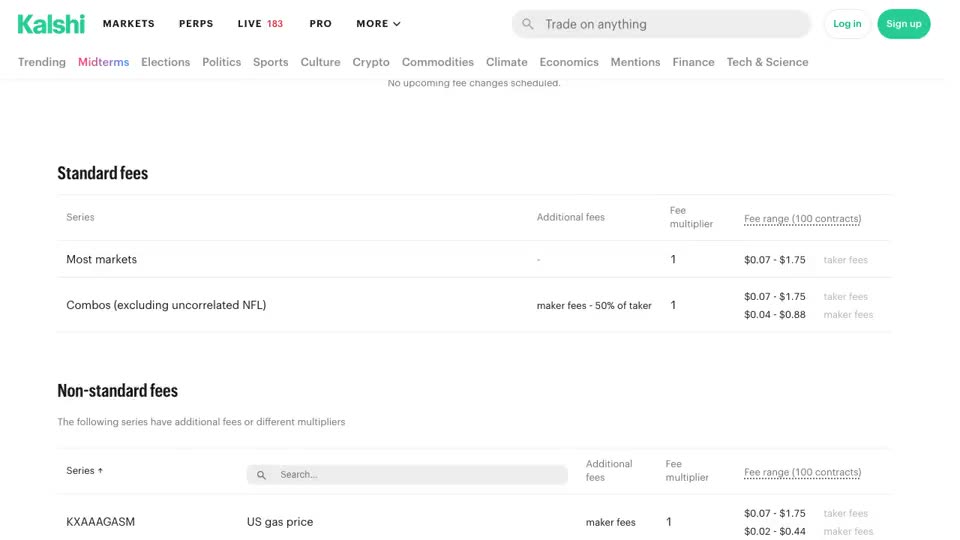
Kalshi’s public fee-schedule page: the standard fees row for most markets and the combos row, each showing a fee range per 100 contracts, then the non-standard series table with its fee multipliers and a count of total series.
The broker: commissions and introducing fees
Interactive Brokers publishes what it charges a customer for event contracts:
ForecastEx Forecast Contracts Contract Type Fees ForecastEx Forecast Contracts USD 0.00 /contract Third Party Fees - Exchange Fee USD 0.01 /contract KALSHI Event Contracts Contract Type Fees KALSHI Event Contracts USD 0.01 /contract Third Party Fees - Exchange Fee USD 0.01 /contract CME Event Contracts Contract Type Fees CME Event Contracts USD 0.01 /contract Third Party Fees - Exchange Fee USD 0.01 /contract
The page lists a commission and a separate third-party exchange-fee line. It does not say how the third-party line relates to an exchange’s own schedule, and this piece does not combine them.
An introducing broker is paid by the futures commission merchant that carries the account, and DraftKings states how it books that:
DraftKings acts as an introducing broker, and therefore revenue is generated from introducing fees, paid by futures commission merchants, and is recognized when customer trades occur.
The filings read do not state the introducing-fee rate or the prediction-markets revenue separately from sports revenue.
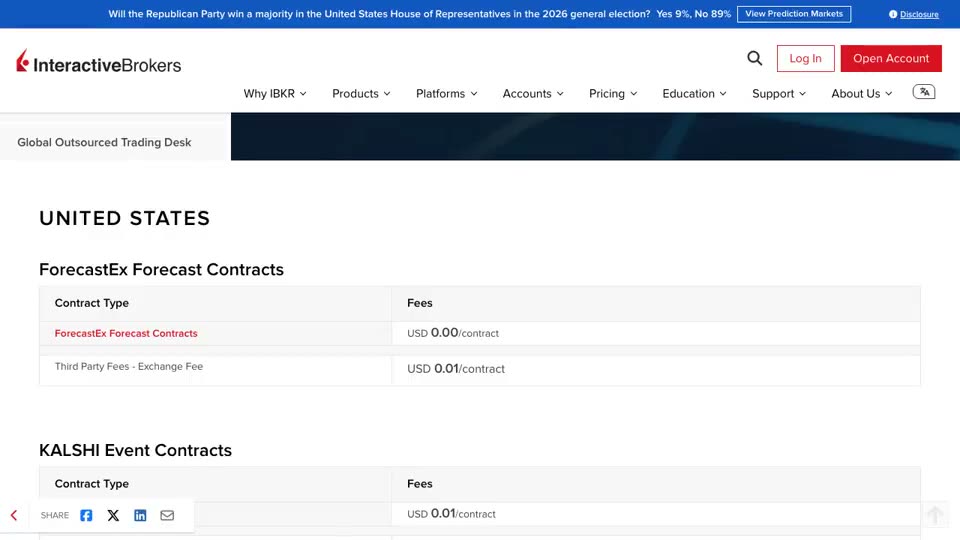
Interactive Brokers’ public commissions page for prediction markets: the United States tables for ForecastEx forecast contracts, Kalshi event contracts and CME event contracts, each with a commission and a third-party exchange fee per contract, then the disclosures under the tables.
The front end: a share and a fee
A front end that fits the staff position for passive software is paid from two sources:
which may also agree to share a specified portion of their relevant revenues with the PSP in exchange for the PSP providing this software to the Registrant’s Users. The PSP will also contract with Users (e.g., via its terms of use) to authorize them to use the software, and this agreement may provide for the PSP to charge a transaction-based fee directly to Users.
The largest reported number in the filings read is Robinhood’s, which reports event contracts as its own revenue line:
Transaction-based revenues: Options $ 265 $ 342 $ 505 $ 602 Event contracts 10 156 13 260 Cryptocurrencies 160 100 412 234 Equities 66 129 122 211 … Event contracts revenues increased primarily due to an acceleration in our prediction markets business, reflecting higher trading activity compared to the same period in 2025 when the offering was still in its early stage.
The columns are the three months and the six months ended June 30, 2025 and 2026, in millions of dollars. Robinhood reports event contracts at 12% of total net revenues for the quarter and 11% for the six months.
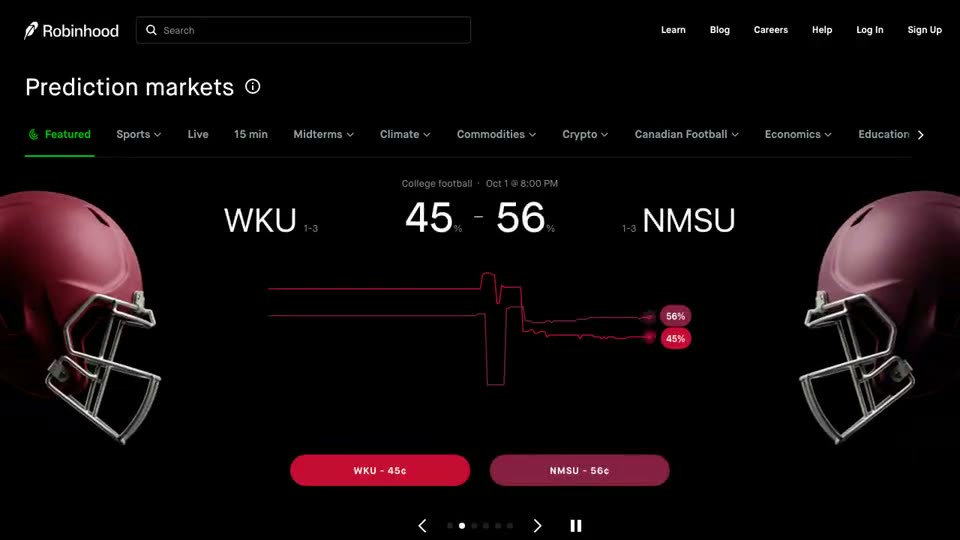
Robinhood’s public prediction-markets page with no account: a row of category tabs, a featured college football game priced in cents per side, a 2027 college basketball championship market, and boards of baseball, tennis, metals-price, MMA and entertainment contracts with percentage prices.
The same filing says its ability to offer event contracts depends on litigation and regulatory action, and Coinbase attributes a rise in one cost line to the exchange fees its prediction-markets business pays:
Our ability to offer event contracts is subject to the outcome of currently ongoing and potential future regulatory enforcement actions and litigation, as well as potential changes in federal or state law, that could immediately or subsequently prevent us from offering, or continuing to offer, event contracts.
Other 37,519 7,055 30,464 432 66,045 18,986 47,059 248 … an increase in other, largely due to exchange fees associated with our prediction markets business.
Amounts are in thousands of dollars. The first two columns are the three months ended June 30, 2026 and 2025, so the line rose from about $7.1 million to about $37.5 million. The filing attributes the increase “largely” to this one cause and does not give a separate figure for it.
Liquidity and partnerships
Kalshi’s liquidity incentive program states its purpose and who is excluded, and CME describes its joint venture with FanDuel without a split:
The purpose of this Program is to increase liquidity on the central limit order book and thereby enhance pricing efficiency. … “Eligible Participants” are all Kalshi members, except the following: (i) affiliates of Kalshi; (ii) members who have executed a Market Maker Agreement with Kalshi; (iii) Introducing Brokers, Futures Commission Merchants, and customers thereof when transacting via the IB or FCM.
The filing shows no payment amounts in the passage quoted. A market-maker business sits behind a member agreement with the exchange, and each exchange’s terms differ.
Our joint venture with FanDuel, a part of Flutter Entertainment plc, launched in December 2025. This partnership introduced a new prediction markets application designed for retail customers. The application offers access to our simplified event contracts covering both major financial and economic benchmarks and sporting events.
The revenue split between the partners is not stated in the filings read.
What a builder does with this
- Model from the schedules. Use the formulas the exchanges publish, dated, and re-read them before relying on a figure: both exchanges’ schedules change by filing.
- Keep each example’s assumptions in the model. One trade at one price shows structure; it does not show a business.
- Check who is excluded from a program before building on it: Kalshi’s referral program excludes introducing brokers and futures commission merchants.
- Treat “not stated” as a task. The introducing-fee rate, the market-maker payments, the data and tooling prices and the partnership splits are not in the records read. Get them from the counterparties.
- Put the filing-disclosed risk next to the revenue. The largest revenue figure comes with a risk factor about litigation and a cost line that rose with the product.