Prediction markets · Brief · 7 min read
Prediction markets: contract categories, and what each needs from a settlement source
The statute and rule that sort event contracts, the Commission’s June 2026 proposal on which categories involve gaming, a court’s ruling on election contracts, three exchange certifications and the state records that concern sports. What the documents say about each category.
A startup choosing what to list or build around has to know how event contracts are sorted by category. The sorting starts with a statute that names the activities a contract may not involve, and it continues in a rule, a proposal, a court ruling and the exchange’s own filings. This brief reads each, category by category, and says what each needs from a settlement source. It counts nothing and does not rank any category; where the documents are silent it says so.
The rule that sorts contracts
The statute lets the Commission treat an event contract as contrary to the public interest if it involves one of six activities:
the Commission may determine that such agreements, contracts, or transactions are contrary to the public interest if the agreements, contracts, or transactions involve— (I) activity that is unlawful under any Federal or State law; (II) terrorism; (III) assassination; (IV) war; (V) gaming; or (VI) other similar activity determined by the Commission, by rule or regulation, to be contrary to the public interest. (ii) Prohibition No agreement, contract, or transaction determined by the Commission to be contrary to the public interest under clause (i) may be listed or made available for clearing or trading on or through a registered entity.
The Commission’s regulation uses the same list as a prohibition on listing:
( a ) Prohibition. A registered entity shall not list for trading or accept for clearing on or through the registered entity any of the following: ( 1 ) An agreement, contract, transaction, or swap based upon an excluded commodity, as defined in Section 1a(19)(iv) of the Act, that involves, relates to, or references terrorism, assassination, war, gaming, or an activity that is unlawful under any State or Federal law
The regulation does not define “gaming” or “involves”. The June 2026 proposal would add definitions of both.
What the Commission has proposed
On June 9, 2026 the Commission approved a proposal to define the two terms. It states them as follows:
The Proposal states that event contracts “involve an activity if their settlement is determined by an occurrence, extent of an occurrence, or contingency in the activity.” The Proposal defines gaming as “any activity that: (i) one or more participants typically engage in for purposes of recreation or to entertain others; (ii) is governed by rules; and (iii) includes measurable occurrences or outcomes that depend on the participants’ luck, skill, or athletic ability during the activity.”
A proposal, not a rule. The definition keys on the activity the contract settles to: recreation, rules, and outcomes that depend on luck, skill or athletic ability during the activity.
The proposal then says which familiar categories it would not treat as gaming, and gives the reason:
Thus, political elections are not gaming. … Similarly, contests like the Nobel Prize and the Academy Awards are not gaming. The outcome of these contests depends on electors’ judgment on who should receive an award based on a range of considerations beyond the participants’ luck, skill, or athletic ability displayed during the contest. … Mere association with athletic performance does not change this analysis. For example, the Cy Young Award, which is presented annually by the Baseball Writers’ Association of America to the two best baseball pitchers, is not gaming.
Under the proposal the test is what the outcome depends on: a vote or an evaluative judgment is not gaming; measurable results of play are. Nothing in the passages quoted classifies economic data or weather, which the proposal’s definition does not address.
Elections and a court
Election contracts were the subject of litigation in 2024. The D.C. Circuit’s ruling on the Commission’s stay motion describes how the district court had decided the question:
The district court found that the Commission erred in categorizing the Congressional Control Contracts as involving either gaming or gambling and vacated its decision. … Because elections are not games, the court concluded that the category does not apply to election contracts.
This is the D.C. Circuit’s account of the district court’s ruling, in an order that denied a stay. The same order states that “the question on the merits is close and difficult”. The merits decision is not covered here.
What a certification has to name
An exchange self-certifies each contract, and each certification has to name the publisher whose number settles it. Three of Kalshi’s recent filings show three categories. A weather contract leaves the source to the listing:
Source Agency: The Source Agency is <source> and will be specified by the Exchange at market listing. The Exchange may list multiple source agencies with a hierarchical ranking.
An inflation contract names the statistical agency that calculates the measure, with a fallback:
Source Agency: The Source Agencies are, in hierarchical order, (i) for <inflation measure>: the statistical agency or entity responsible for the calculation and release of <inflation measure> (e.g., Bureau of Labor Statistics, Eurostat, Office for National Statistics, Bank of Japan), followed by Trading Economics;
An awards contract names the announcer and then a ranked list of news organizations:
Source Agency: The Source Agencies are, in hierarchical order, E! (including the official list of nominees published by E! at peopleschoice.com and eonline.com, and E!'s press office and nominations announcement, produced in partnership with Bob Bain Productions and Berlin Entertainment), the Associated Press, Bloomberg News, Reuters, the New York Times, the Washington Post, CNBC, BBC, ABC, CBS, CNN, Fox News, MS Now, NBC, and the Wall Street Journal.
The class certification covers contracts that use the identical source hierarchy and settlement formula as one previously certified contract, which the filing identifies.
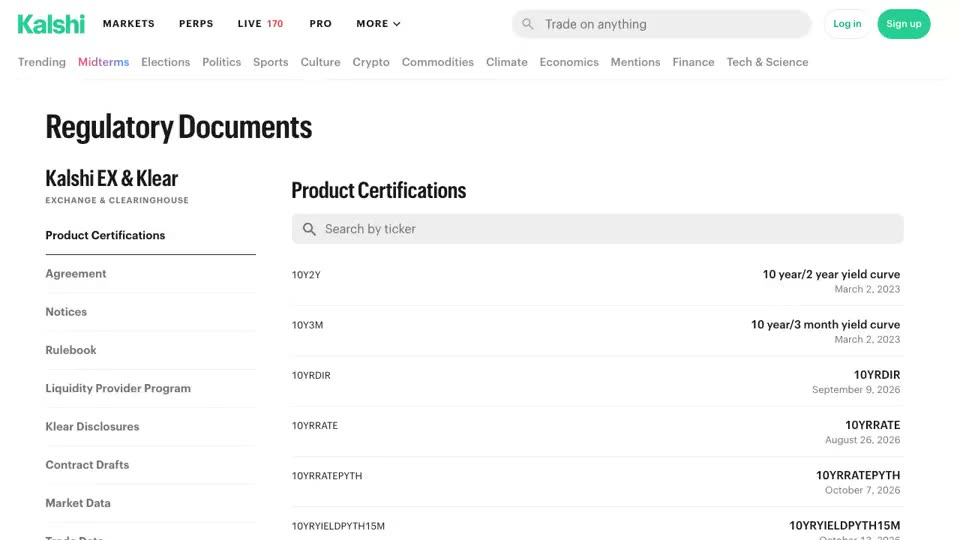
Kalshi’s public Product Certifications page: the list of certified contracts by ticker, with a search box and a date beside each entry, scrolled through the first entries to the “Load more” control.
What the state records concern
Two state records read for this series state which contracts they address. Missouri’s Attorney General wrote to Robinhood Derivatives on September 16:
Robinhood is an online sports wagering platform offering sports wagering to individuals located in the State of Missouri, despite not submitting to regulation by the Missouri Gaming Commission as required by Missouri law.
This is the Attorney General’s position. The letter concerns sports wagering.
Michigan’s Gaming Control Board announced a court-approved agreement on September 9:
Robinhood Derivatives, LLC has agreed to stop offering new sports-related event contracts to Michigan customers by the end of the day Wednesday, and to close out any remaining customer positions by October 9, under a court-approved agreement.
The agreement does not concede either side’s legal position, as the release states elsewhere.
A broker’s own restrictions show the same line. Robinhood’s help page names one state that bars all its event contracts and one that bars new sports contracts:
State restriction: Maryland residents can't trade event contracts. Nevada residents can't open new sports contracts (as of December 1, 2025).
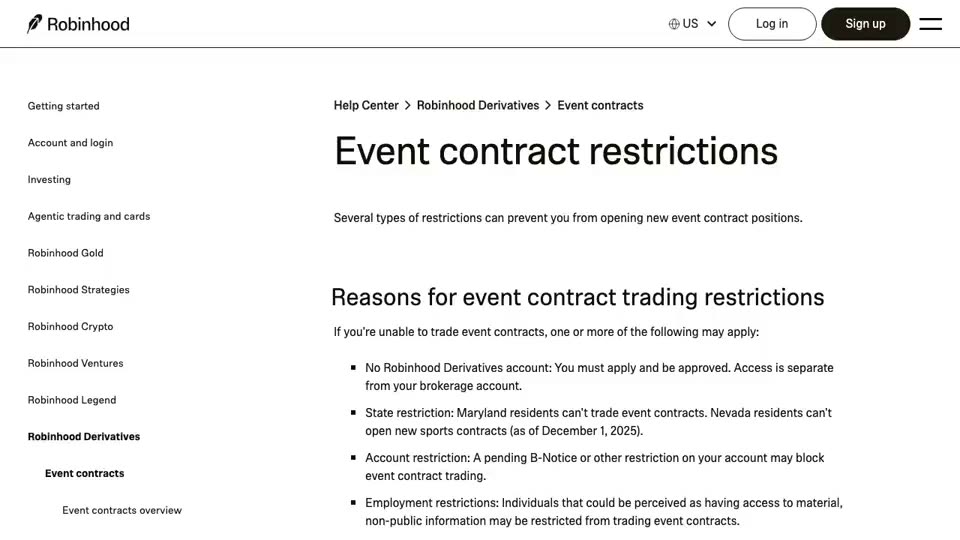
Robinhood’s public help page on event contract restrictions, scrolled from the state restriction naming Maryland and Nevada, through the position-closing-only rule applied when an eligibility or state change is detected, to the “stricter area” geolocation error and its causes.
Each of the two state records and the broker’s page concerns sports contracts, or all contracts in one state. None of the three addresses a weather, economic or awards contract. That is a statement about these three documents. It is not a statement about any state’s law on those categories, which the documents do not address.
What a builder does with this
- Sort each contract by what it settles to. The Commission’s proposal turns on whether the outcome depends on measurable results of play, or on a vote or a judgment. Write that sentence for every contract you plan to list.
- Treat the proposal as a proposal. Its definitions are not final, and the 2024 election ruling is a stay order. Build to the current rule and note what would change if the proposal were adopted.
- Name the settlement source in the contract, as the certifications do: the publisher, a ranked fallback, and what happens when the source revises. A government statistical agency, a weather service and an awards announcer each need their own terms.
- Check the source’s own rules. A source agency can become a prohibition in the exchange’s rules, as the integrity brief in this series shows, so list contracts whose sources you have read.
- Keep the state map by category. The state records read concern sports contracts, and a broker’s page can restrict by category within a state. Do not read silence about another category as permission.