Prediction markets · Deep dive · 28 min read
Prediction markets: building on the Phantom letter — passive software, introducing broker or commodity trading advisor
CFTC staff’s September 2026 no-action position lets a front end for regulated event contracts launch without registering as an introducing broker, on ten conditions. What the position lets a startup build and charge for, which designs sit outside it, and what the registered paths cost, from the letters, the rules and NFA’s own pages.
A startup that wants to put a front end on regulated event contracts has three ways to do it, and the choice is made by the product, not by the label “software”. The first is to build inside a staff no-action position that lets a passive software provider market and distribute a front end without registering. The second is to register as an introducing broker and join the National Futures Association. The third is to be, or to be exempt from being, a commodity trading advisor, which answers a different question: whether the product tells anyone what to trade.
The legal reading of the staff letters sits in the derivatives series, in the brief on a software layer over a prediction market and in the guide to NFA and CFTC registration. This piece is the playbook that follows from it. For each product decision it says which path the decision keeps you on, what the path costs where a public schedule states a cost, and where the letter is silent. A staff letter is not a rule: each one binds only the Division that issued it, and the sections below say what that means for a build.
The decision in one table
| The question | Passive software (Staff Letter 26-25) | Introducing broker | Commodity trading advisor |
|---|---|---|---|
| What it covers | A front end that shows market data, shows positions and sends the user’s orders straight to a registrant; marketing and soliciting users to specific registrants | Soliciting or accepting orders for futures, options or swaps, without taking customer money | Advising others, for pay, on the value of trading or whether to trade |
| What you file | A notice to the Division agreeing to the conditions, and a written undertaking with each registrant | NFA’s Form 7-R and membership application; Form 8-R, fingerprints and proficiency for each principal and associated person | NFA’s Form 7-R and Form 8-R, unless an exemption applies |
| Published fees | None stated in the letter | $200 application fee; $750 dues; $85 per principal or associated person not already registered | $200 application fee; $750 dues; $85 per principal or associated person not already registered |
| Money rule | Provider never holds, controls or takes custody of user assets | Takes no customer funds; $45,000 minimum adjusted net capital or a guarantee agreement | No net-capital figure on the NFA page read |
| Where it stops | Signals, discretion over routing or execution, custody and anything outside the “Covered Activities” | Holding customer funds is the futures commission merchant line | Advice built on a user’s own positions needs registration or another exemption |
| Who sets the terms | Division staff; revisable at its discretion until a Commission rule or guidance | Statute, Commission rules and NFA rules | Statute, Commission rules and NFA rules |
Path one: the passive-software position
On March 17, 2026 the Commission’s Market Participants Division gave one self-custodial wallet developer, Phantom Technologies, Inc., a no-action position under Commission Regulation 140.99: it would not recommend enforcement for failure to register as an introducing broker, or for its personnel’s failure to register as associated persons, if the developer stayed within the activities it had described and met ten conditions. On September 17 the Division widened the position. The Commission’s release says who may use it:
The position is similar to that provided in Staff Letter 26-09 and now is broadly available to such providers. The letter states that, subject to certain specified conditions, MPD will not recommend the Commission take enforcement action against any such provider or their relevant personnel for failure to register as an introducing broker or associated person of an introducing broker.
The letter itself says the position is not limited to crypto products and rests on the same terms as the original:
The Division believes that a no-action position for all PSPs on substantially the same terms as that provided to the software developer in Letter 26-09 is warranted. … For the avoidance of doubt, PSPs are not limited to providers of crypto asset related software.
A product that has nothing to do with wallets can use the position, on the conditions below. Only the beneficiary of a no-action letter may rely on it, so Phantom alone relies on 26-09 and every other provider relies on 26-25.
What the letter lets you build
The position covers a defined list of activities, which the letter calls “Covered Activities”. The first is the product itself: a front end that shows data and positions and lets the user send orders to a registrant.
The PSP will develop and distribute front-end interface software for Users to review market data and aggregate position information, view information about product offerings, and submit orders for Commission-regulated derivative products directly to Registrants, including event contracts, perpetual contracts, and other Commission-regulated derivatives. The PSP’s involvement in order submission will be limited to providing software on the User’s device, which enables the User to transmit its orders directly to Registrants. The PSP will not have any affirmative involvement with any particular orders.
The letter describes software on the user’s device that sends orders directly. A design in which orders pass through the provider’s own servers before reaching a registrant is not what the letter describes.
The second and third items are about money and marketing. They are the reason this position matters commercially: the provider may be paid and may sell.
The PSP will offer this access to Commission-regulated derivative products by contracting with one or more Registrants, which may also agree to share a specified portion of their relevant revenues with the PSP in exchange for the PSP providing this software to the Registrant’s Users. The PSP will also contract with Users (e.g., via its terms of use) to authorize them to use the software, and this agreement may provide for the PSP to charge a transaction-based fee directly to Users. … will market its services and relationships with the relevant Registrants to promote these activities, including promoting the availability of particular derivatives contracts. … will introduce Users to—and solicit Users to engage with—specific Registrants, but Users will face no contractual or operational restriction from accessing those Registrants directly, without the PSP’s involvement.
Revenue share from the registrant, a per-transaction fee from the user, marketing of particular contracts and soliciting users to named registrants are all inside the described activities. The user must stay free to go to the registrant directly.

A wallet front end for event contracts: Phantom’s public Prediction Markets page shows in-app screens with a basketball game priced in percentages and a “Make your prediction” control, then opens the FAQ answer stating that its markets are powered by Kalshi via DFlow and that users do not open a Kalshi account.
The line the letter draws: custody, signals, discretion
The position is built on what the provider never does. The letter limits it to a “custodial” market structure, where the user’s funds sit with the exchange’s clearinghouse or a futures commission merchant, and it names three things the provider does not do.
Further, “Covered Activities” are limited to circumstances where a User is transacting on a DCM either directly as a member of the DCM or indirectly as a customer of an FCM or IB that is a member of the DCM. In these instances, the User would also maintain the funds or other property securing its derivatives positions in custody with the DCM’s derivatives clearing organization (“DCO”) and/or an FCM that is a member of such DCO. In that sense, the Covered Activities envision a “custodial” model of trading that is consistent with existing market structure for exchange-traded derivatives. The PSP’s software would serve only to passively enable Users to transact in Commission-regulated derivatives products. At no point would the PSP hold, control, or take into custody User assets, generate express “buy” or “sell” signals, or exercise discretion with respect to the routing or execution of User orders.
Three product decisions are fixed by this paragraph: where the money sits, whether the product tells the user what to trade, and who decides where an order goes. The sections on designs outside the position return to each.
Earlier staff letters for technology vendors used a stricter list: a pre-existing customer relationship with a broker, no recommendation of any broker even on request, no buy or sell signals, and fees unrelated to the broker’s fees. The 2026 position drops the first, second and fifth of those for a provider that meets its own conditions, and keeps the signals line. That difference is the commercial opening: a front end may now introduce users to a registrant and be paid for it.
The ten conditions as a build list
Each of the letter’s ten conditions turns into either a product feature or a contract. The table states what the letter requires and what the builder has to produce. The paraphrases are ours; the next two excerpts quote the conditions that most affect a launch.
| Condition | What the letter requires | What the builder produces |
|---|---|---|
| 1 | The provider, its principals and anyone soliciting users are not subject to statutory disqualification, absent a Division waiver; notify the Division if that changes | A background review of principals and sales staff before launch, and a standing duty to report |
| 2 | A disclosure of the provider’s relationship with each registrant, including conflicts and fees, that each user acknowledges | An onboarding screen and an acknowledgement record |
| 3 | A risk disclosure covering the risks in 17 CFR 1.55(b), to the extent relevant, kept with a record of the user’s acknowledgement; not required where a registered registrant already gives it | Terms of service or onboarding text, plus an acknowledgement log |
| 4 | Users are onboarded as direct members of the exchange or customers of the broker, and keep the ability to reach the registrant independently | Account-opening that happens with the registrant, and no technical or contractual lock-in |
| 5 | Policies and procedures for communications with the public as if the provider were registered as an IB | A written marketing policy and a review step |
| 6 | No advertising or promotion that would need NFA pre-approval under Compliance Rule 2-29 if the provider were registered | A list of promotional formats the product team does not run |
| 7 | A written undertaking with each registrant: joint and several liability for violations by the provider or its personnel in the covered activities, and consent to CFTC jurisdiction; filed with the Division | A negotiated contract with every exchange or broker you connect to |
| 8 | Records kept consistent with 17 CFR 1.31 | A records system and a retention schedule |
| 9 | Notice to the Division if the provider becomes insolvent or enters bankruptcy | A trigger in the finance and legal runbook |
| 10 | A filed notice agreeing to satisfy the conditions and consenting to the Commission’s jurisdiction | A one-time filing to the Division at its published address |
The PSP provides, and each User acknowledges receipt of, disclosures regarding the PSP’s relationship with the relevant Registrant(s), addressing potential conflicts of interest (including fees). … Users are onboarded as direct members (for DCMs) or customers (for registered FCMs and IBs), and they continue to have the ability to access the respective Registrant independently of the PSP.
The disclosure has to reach the user and be acknowledged, not only be posted. The onboarding condition is about who the user’s counterparty relationship is with.
The PSP does not engage in advertising or promotions that, if the PSP were registered as an IB, would require pre-approval by NFA under NFA Compliance Rule 2-29. … The PSP and each of its Registrants execute in writing an undertaking by which they each agree to be jointly and severally liable for any violations of the Act or Commission regulations by the PSP or any of its personnel when the PSP or its personnel engage in the Covered Activities with or on behalf of such Registrant. … The PSP files each of these undertakings with the Division.
The undertaking is the condition that makes the exchange or broker a party to the product. A provider cannot meet it alone: the registrant has to sign.
What a provider tells its users
Conditions 2, 3 and 5 put words in front of the user: the relationship with the registrant, the fees, and the risk of trading. A front end’s public pages and terms are where those words live. Phantom’s Prediction Markets page carries a short line on availability, fees and loss:
Prediction markets in Phantom are not available in all jurisdictions. Trading prediction markets may incur transaction fees and other costs. If your prediction is incorrect, you may lose the entire amount you allocate to an event. References to third parties are informational only and do not imply endorsement or affiliation.
A page line like this is one place a disclosure appears. The letter asks for a disclosure that each user acknowledges, and for a record of that acknowledgement; this piece does not read any product’s pages against the letter.
A provider’s terms are where it says what the software is and is not. Phantom’s general Terms of Use, last updated March 17, 2026, state the wallet’s role in these words:
Phantom is a developer and supplier of software. Phantom is not a broker, nor is it a dealer or arranger, nor does it operate a Digital Asset exchange platform or offer trade execution or clearing services and, therefore, has no oversight, involvement, or control concerning the transactions you choose to conduct via the Functionality. … Phantom is not acting as an investment manager, adviser, arranger, introducer, broker, dealer, virtual asset service provider or commodity trading adviser to any person or entity.
These are the wallet’s general terms, which cover its digital-asset functionality. They are quoted for how a software provider states its role in its own terms, not as terms written for prediction markets.
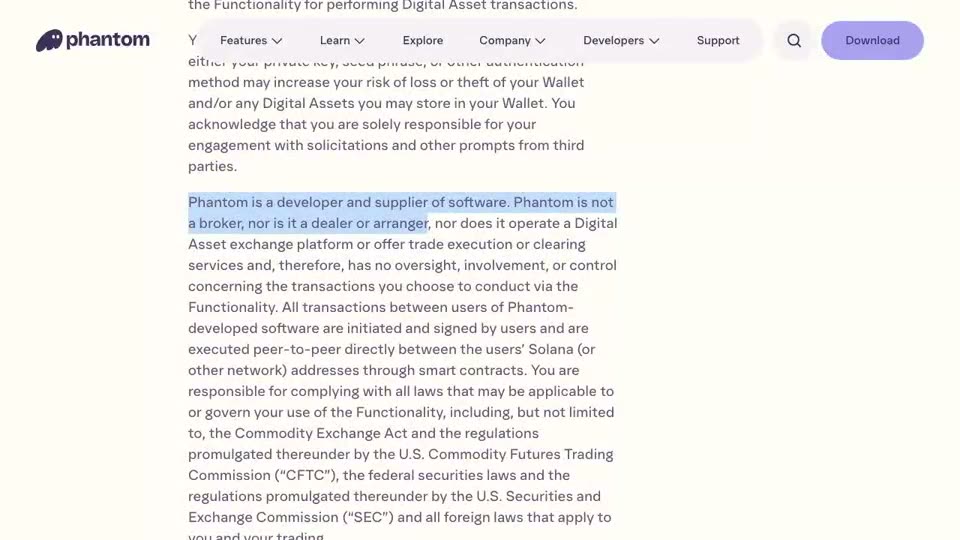
Phantom’s public Terms of Use, dated March 17, 2026: the custody, broker and adviser passages, highlighted in turn.
A statement of role in the terms is a statement, not a registration answer. The staff position turns on what the software does, which is why the conditions ask for acknowledged disclosures and a signed undertaking rather than for a description in the terms.
The exchange is the counterpart
Condition 7 needs a registrant willing to sign the undertaking, and the letter’s “Registrants” are the exchange itself, a futures commission merchant or an introducing broker. A startup therefore builds against whichever of those will contract with it, and their rulebooks decide what is available. Kalshi’s rulebook, for example, writes its intermediary rule for introducing brokers and sets its terms:
Kalshi will allow IBs access to the Platform and related services in an impartial, transparent, fair and non-discriminatory manner, including to enable the Customers of IBs who are not Members of Kalshi to become IB Customers. … (b) To be eligible to become an IB, an applicant must: a. be validly organized, in good standing, in the United States; b. be registered as an Introducing Broker by the CFTC and a member of NFA; c. execute the IB Agreement; d. have adequate financial resources and credit as required by Commission Rule 1.17; … (e) An IB may only submit Orders for an IB Customer if the IB Customer is a Self-Clearing Member at Clearing House or clearing at Clearing House through a futures commission merchant that is a clearing member (or equivalent term) of Clearing House.
The rule describes an introducing-broker program: registration, NFA membership, capital and clearing through a futures commission merchant. It does not describe an arrangement for a provider relying on Letter 26-25. Whether and how an exchange contracts with such a provider is for the exchange and the provider to settle.
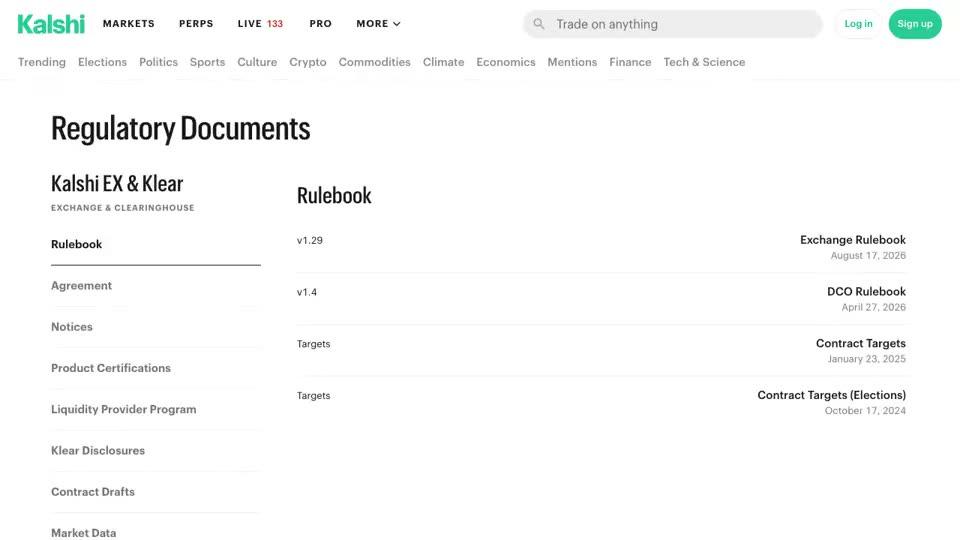
Kalshi’s public regulatory documents page: the Exchange Rulebook v1.29 dated August 17, 2026, the DCO Rulebook, links for agreements, notices and product certifications, a heading for Kalshi Prime LLC (FCM), then the site footer.
For a builder this changes the order of work. The conversation with a registrant comes before the product is final, because the undertaking, the revenue-share terms and the onboarding flow are all contract terms. The letter’s position is also a position about facts. The Division’s closing paragraph says what happens if the facts it was given are not the facts that exist:
This letter, and the position taken herein, represent the views of the Division only, and do not necessarily represent the position or view of the Commission or of any other office or division of the Commission. This letter and the no-action position taken herein are not binding on the Commission. … Any different, changed or omitted material facts or circumstances might render the position taken in this letter void. Finally, as with all staff letters, the Division retains the authority to condition further, modify, suspend, terminate, or otherwise restrict the terms of the position taken herein, in its discretion.
The position runs until the effective date of a Commission rulemaking or guidance on software providers. In the meantime a product change that alters a described fact, such as adding custody or a recommendation engine, is a change to the facts the position rests on.
What the letter lets you charge for
Compensation is where software and brokerage meet, and the Commission’s older view was strict. The letter quotes the Commission’s 1983 release in a footnote:
persons who are currently compensated on a per-trade basis or by a referral fee as described above would be deemed to be the ‘agent’ of a futures commission merchant for the purpose of the acceptance of those customer orders
The definition of an introducing broker carries the same idea, “direct or indirect” compensation:
(1) Any person who, for compensation or profit, whether direct or indirect: (i) Is engaged in soliciting or in accepting orders (other than in a clerical capacity)
The 2026 position works inside that definition rather than around it. Compensation that the old rule treated as a mark of an introducing broker is now described, within the covered activities, as a permitted feature of a passive software provider. The table sets each revenue model against what the letter says. A model the letter does not mention is not forbidden by silence and is not covered by it either.
| Revenue model | In the letter’s described activities? | What to settle |
|---|---|---|
| A share of the registrant’s revenues for providing the software to its users | Yes: the registrant “may also agree to share a specified portion of their relevant revenues” | The share in the contract with each registrant; disclosure to users under condition 2 |
| A transaction-based fee charged directly to users | Yes: the user agreement “may provide for the PSP to charge a transaction-based fee” | The fee in the terms of use; disclosure of fees under condition 2 |
| Marketing and soliciting users to named registrants and particular contracts | Yes, with personnel activity pre-approved and supervised, and no promotion needing NFA pre-approval under Rule 2-29 | A marketing policy, a review process and a list of formats not used |
| A flat subscription or a free app with no per-trade element | Not addressed | The letter lists two revenue sources and does not mention a flat fee; ask counsel and, if the facts change, tell the Division |
| Payment from anyone other than a registrant or the user | Not addressed | The letter describes payment by registrants and users only |
| A fee that varies with the user’s profit, or a share of user winnings | Not addressed | Not among the described fees; the compensation facts are part of what the position rests on |
Designs outside the position
The position covers what the letter describes. Features outside the description need their own analysis, and the analysis starts from the verb the feature performs. The statutes below are the ones the letter’s own limits point to. None of what follows says a design is unlawful; it says which question the design raises.
The first limit is custody. The futures commission merchant is the role defined by taking money to secure trades:
accepts any money, securities, or property (or extends credit in lieu thereof) to margin, guarantee, or secure any trades or contracts that result or may result therefrom
A product that holds a balance the user draws on to trade is describing a fact the letter’s custodial model excludes. Money transmission law is a separate question, covered in the payments series.
The second is pooling. A product that gathers users’ money into one account to trade for them describes a commodity pool operator:
engaged in a business that is of the nature of a commodity pool, investment trust, syndicate, or similar form of enterprise, and who, in connection therewith, solicits, accepts, or receives from others, funds, securities, or property, either directly or through capital contributions, the sale of stock or other forms of securities, or otherwise, for the purpose of trading in commodity interests
The letter does not mention pooled accounts or vaults. Its facts are that each user holds a position with a registrant.
The third is advice. Signals, rankings that tell the user what to buy and copy trading all raise the commodity trading advisor question. The statute reaches advice given “through publications, writings, or electronic media”, with an exclusion for publishers of data of general and regular dissemination that applies only where the advice is solely incidental to the publisher’s business:
(i) for compensation or profit, engages in the business of advising others, either directly or through publications, writings, or electronic media, as to the value of or the advisability of trading in— … (iv) the publisher or producer of any print or electronic data of general and regular dissemination, including its employees; … Subparagraph (B) shall apply only if the furnishing of such services by persons referred to in subparagraph (B) is solely incidental to the conduct of their business or profession.
The statute does not say how the publisher exclusion applies to a product whose whole business is market analysis.
| Feature | What the letter’s text says | Where the analysis goes |
|---|---|---|
| Buy or sell recommendations, “picks”, or signals | The provider does not “generate express ‘buy’ or ‘sell’ signals” | Commodity trading advisor definition, § 1a(12); the exemptions in 17 CFR 4.14, below |
| Copy trading: mirroring another user’s trades into a user’s account | Not mentioned. The facts given are “no affirmative involvement with any particular orders” and no discretion over “routing or execution” | Advice and account direction under 17 CFR 4.14(a)(9); who places the order |
| A balance the provider holds for users, or pre-funded wallets | The user’s funds stay with the clearinghouse or a futures commission merchant; the provider does not “hold, control, or take into custody User assets” | Futures commission merchant definition, § 1a(28); money transmission law |
| Pooled accounts or vaults | Not mentioned | Commodity pool operator definition, § 1a(11); registration under § 6m(1) |
| Smart routing: the product chooses the venue or timing | The provider does not “exercise discretion with respect to the routing or execution of User orders” | Whether the position’s facts still hold; introducing broker registration |
| Orders relayed through the provider’s servers | The letter describes “software on the User’s device” that transmits orders to registrants | Whether the position’s facts still hold |
Each row is a design choice with a condition. A provider that wants one of these features has two routes: keep it out of the first release and build inside the position, or take the feature to a registered path, which the next sections price.
Path two: register as an introducing broker
Registration answers the question the letter leaves to staff discretion. The statute makes it unlawful to act as an introducing broker without registering:
(g) Introducing broker registration requirements It shall be unlawful for any person to be an introducing broker unless such person shall have registered under this chapter with the Commission as an introducing broker and such registration shall not have expired nor been suspended nor revoked.
The Commission registers introducing brokers through the National Futures Association, and every registered introducing broker is a member. NFA’s page lists the steps and the fees:
All registered IBs must be NFA Members. … To register as an IB and become an NFA Member: Designate a Security Manager in order to obtain secure access to NFA's Online Registration System (ORS) Complete online Form 7-R Complete online NFA membership application Satisfy compliance requirements for IB applicants Complete online Member Questionnaire Pay a non-refundable application fee of $200 Pay non-refundable IB membership dues … Complete online Form 8-R for each principal and AP Get fingerprinted Satisfy proficiency requirements for each sole proprietor, AP, forex AP and swap AP Pay a non-refundable application fee of $85 for each principal and AP
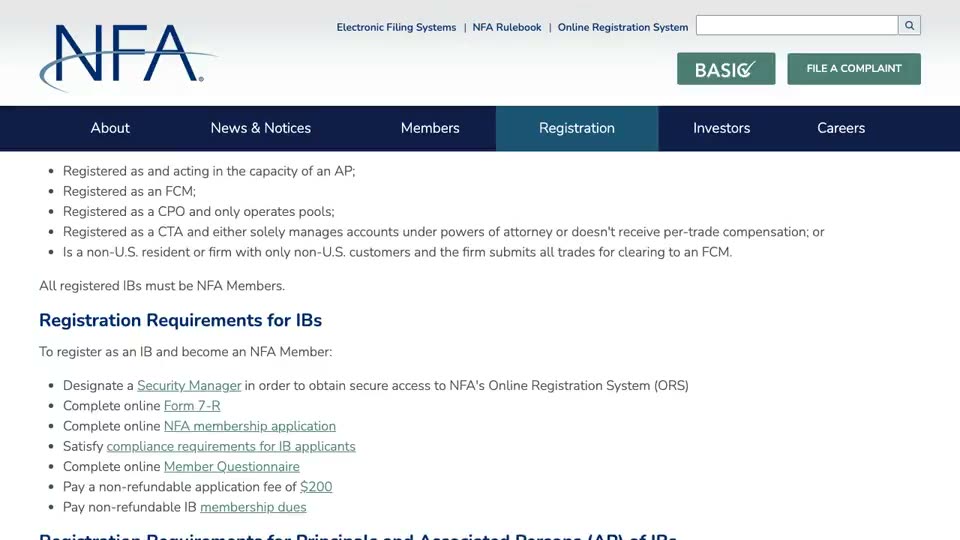
NFA’s public introducing-broker page: who is exempt from registering, then the steps to register as an IB and join NFA, with the $200 application fee and the dues line, then the separate steps and $85 fee for each principal and associated person.
What it costs, from the published schedules
NFA publishes its membership dues, and the dues table lists the introducing-broker rows:
Introducing Broker $750 Introducing Broker Forex Firm $2,500 Introducing Broker Swaps Firm $2,500 … Commodity Trading Advisor $750 Commodity Trading Advisor Forex Firm $2,500 Commodity Trading Advisor Swaps Firm $2,500
The same figures appear under the page’s initial and annual dues headings. Which row applies to a firm that offers event contracts depends on whether the business includes swaps, a classification the Commission proposed on October 9 to settle by rule (see the section on pending items).
The money rule for an introducing broker is a capital rule. The Commission’s regulation sets a floor, lets NFA set a higher one, and offers an alternative for a broker that operates under a guarantee agreement with a futures commission merchant:
(iii) Except as provided in paragraph (a)(2) of this section, each person registered as an introducing broker must maintain adjusted net capital equal to or in excess of the greatest of: (A) $45,000; (B) The amount of adjusted net capital required by a registered futures association of which it is a member; … (ii) The minimum requirements of paragraph (a)(1)(iii) of this section shall not be applicable to an introducing broker which elects to meet the alternative adjusted net capital requirement for introducing brokers by operation pursuant to a guarantee agreement which meets the requirements set forth in § 1.10(j).
NFA’s compliance page for applicants says how it reads the capital rule in practice and what it reviews before approving an applicant:
Generally, NFA expects an IB to maintain adjusted net capital of at least $50,000 to ensure that the firm does not fall below the capital requirement if it incurs unexpected liabilities. … If applying as a guaranteed IB, the firm must file the appropriate guarantee agreement and will not be subject to the minimum net capital or financial reporting requirements. … An IB will not be approved until NFA reviews and approves all requested items.
Putting the published figures together gives a fee floor, with an assumption stated so it can be changed. Assume a firm with two principals who are also its associated persons, neither already registered with the Commission. NFA’s page says only one application fee is required when a person files as both an associated person and a principal. NFA’s fees are then $200 for the firm, $750 in dues and $85 for each of two people, which is $1,120. The proficiency requirement for associated persons is the National Commodity Futures Examination (Series 3) in most cases, and the exam, fingerprinting and any guarantor or accountant are separate costs that the pages read do not state. The capital requirement is $45,000 under the rule, or $50,000 as NFA says it generally expects, unless the firm operates under a guarantee agreement. NFA’s pages state no processing time.
| Cost line | Published figure | Source |
|---|---|---|
| Firm application fee | $200, non-refundable | NFA, IB Registration |
| Annual dues, introducing broker | $750 (initial and annual rows) | NFA, Membership Dues and Fees |
| Annual dues, IB swaps firm | $2,500 | NFA, Membership Dues and Fees |
| Application fee per principal or associated person | $85, not owed by a person already CFTC-registered or listed as a principal of a registrant | NFA, IB Registration |
| Minimum adjusted net capital | $45,000, or the higher amount NFA requires; NFA says it generally expects $50,000 | 17 CFR 1.17(a)(1)(iii); NFA, IB Applicant Compliance Requirements |
| Guaranteed alternative | Guarantee agreement filed instead; no minimum net capital or financial reporting requirement | 17 CFR 1.17(a)(2)(ii); NFA, IB Applicant Compliance Requirements |
| Worked example (assumption: two principals who are also the APs, neither already registered) | $200 + $750 + 2 × $85 = $1,120 in NFA fees, before exam, fingerprinting, accountant and guarantor costs | Arithmetic on the figures above |
| Time to approval | Not stated on the pages read | — |
What registration adds, and what it does not
The registered path removes the dependence on a staff letter. The firm is an introducing broker, the definition no longer needs a no-action position to fit it, and the features in the “designs outside” table that are brokerage activity (soliciting and accepting orders, routing orders to a futures commission merchant) become part of the licensed business. The conditions of the letter that read as if the provider were registered, namely disclosure, marketing rules and records, apply to the registered firm directly. Registration does not change the money line. An introducing broker takes no customer funds: the futures commission merchant that carries the account holds them, which is why exchange rules such as Kalshi’s require an introducing broker’s customer to clear through a clearing member.
For a startup the choice between paths one and two is a choice about sequence. The passive-software position needs a filed notice, a signed undertaking with each registrant and a set of acknowledged disclosures, and carries no stated fee. Registration needs an NFA application, a named principal who is an associated person, capital or a guarantee, and approval by NFA before launch. A team that wants advice, routing or pooling features in a first release is describing the registered path.
Path three: commodity trading advisor
The introducing broker question is about orders. The commodity trading advisor question is about advice, and Letter 26-25 says nothing about it: it addresses introducing broker and associated person registration only. A front end with any analysis, ranking or alert feature has to answer the advice question separately. The statute makes it unlawful to act as a commodity trading advisor without registering, with an exemption for an advisor who has not advised more than fifteen persons in twelve months and does not hold itself out to the public:
It shall be unlawful for any commodity trading advisor or commodity pool operator, unless registered under this chapter, to make use of the mails or any means or instrumentality of interstate commerce in connection with his business as such commodity trading advisor or commodity pool operator: Provided, That the provisions of this section shall not apply to any commodity trading advisor who, during the course of the preceding twelve months, has not furnished commodity trading advice to more than fifteen persons and who does not hold himself out generally to the public as a commodity trading advisor.
The exemption turns on two things, the count and not holding oneself out generally to the public. A consumer front end open to anyone is the case the second condition addresses.
The Commission’s regulation supplies a second exemption keyed to what the advice is, not how many people receive it. It is the exemption for advice that is not tailored to a particular client:
(9) It does not engage in any of the following activities: (i) Directing client accounts; or (ii) Providing commodity trading advice based on, or tailored to, the commodity interest or cash market positions or other circumstances or characteristics of particular clients
This is an exemption from registration, not from the definition. The same chart, the same consensus odds and the same alert for every user sit on one side; a signal built from a user’s own positions, or an account the product trades, sits on the other.
NFA’s page for advisors lists three exemption criteria from the regulation and sets out the registered route: a $200 application fee and an $85 fee per principal or associated person, with dues of $750 on the dues table above:
CFTC Regulation 4.14 details the criteria that must be met for exemption from CTA registration, including: Advice was provided to 15 or fewer persons during the past 12 months and the entity does not generally hold itself out to the public as a CTA; or Entity is CFTC registered and advice is solely incidental to its business or profession; or Advice is provided that is not based upon knowledge of or tailored to a customer's particular trading account or trading activity. … Pay a non-refundable application fee of $200 … Pay non-refundable CTA membership dues
The practical rule for a build is to treat advice as a product line with its own gate. Charts, depth, settlement-source links, market rules and identical alerts for every user are general information. A feature that reads a user’s positions, recommends a trade from them, or copies another user’s orders into an account is the tailored case. A team can ship the general features inside path one and add the tailored ones later through a registered path.
What states have said about intermediaries
Federal registration answers the Commodity Exchange Act question. It does not answer whether a state treats an event contract on a sporting event as a wager, a question being litigated in the courts of appeals and covered in the prediction-markets series. Two recent state records are addressed to a company that offers event contracts to the state’s residents through its app. Missouri’s Attorney General wrote on September 16:
Robinhood is an online sports wagering platform offering sports wagering to individuals located in the State of Missouri, despite not submitting to regulation by the Missouri Gaming Commission as required by Missouri law. At this time, Robinhood has two options: (1) it must cease and desist from such activity; or (2) it must (a) obtain a license from the Missouri Gaming Commission, (b) pay all associated state taxes and fees, and (c) stop offering sports wagering to persons in the State of Missouri under the age of 21.
This is the Attorney General’s position, in the letter’s words. The letter also describes the platform as having claimed that its contracts are governed by the Commodity Exchange Act.
Michigan’s Gaming Control Board announced a court-approved agreement a week earlier, and the Board’s release states that the agreement reserves each side’s position:
The agreement does not concede any party’s legal position — it preserves both sides’ rights and defenses, including Robinhood’s argument that its federally structured contracts are not subject to state regulation. The agreement will remain in effect until the Sixth Circuit appeals are resolved.
Neither record mentions a passive software provider, and neither says what a state would do about one. What they show is where these two states directed their letter and agreement: at the company that offers event contracts to the state’s residents. A startup that distributes a front end should expect its registrant’s state-law position to bear on the product, and should ask each registrant which states it serves before building a launch map.
What is pending at the Commission
On October 9 the Commission approved a proposal to define the term “swap” to include event contracts. Comments are due thirty days after publication in the Federal Register.
Consistent with its jurisdiction over swaps, the Commodity Futures Trading Commission (“Commission” or “CFTC”) is proposing to further define the term “swap” to explicitly include event contracts, including those based on sports-, politics-, cultural-, and weather-related events (the “Proposal”).
This is a proposal. It is about the definition of “swap”, not about software providers. It bears on a builder’s planning in two places: how the contract is classified, and the NFA rows (swap firm dues, swap AP proficiency) that depend on that classification.
The letter’s own position ends on a Commission rulemaking or guidance on software providers. No such rulemaking or guidance had issued on the date these sources were read, and the Commission’s release on the passive-software position calls it a staff action. A startup relying on the position is relying on staff discretion that the Division reserved the right to change.
What a builder does with this
- Write the product as verbs before writing code: display, transmit, hold, advise, decide. Each verb maps to a row above, and each row has a path.
- Decide the first release’s path from the features, not the other way round. A front end that shows data, shows positions and sends the user’s own orders straight to a registrant fits path one. Recommendations, copy trading, pooled or pre-funded balances and smart routing belong to a registered path or to a later release.
- Open the registrant conversation first. The written undertaking, the revenue share, the onboarding flow and the states served are all contract terms, and condition 7 cannot be met without a signature.
- Build the acknowledgement trail on day one: the relationship and fee disclosure, the risk disclosure and a log of each user’s acknowledgement, with records kept to the Commission’s retention rule.
- Set the fee model against the letter’s two described sources, a registrant’s revenue share and a per-transaction fee charged to users. If the plan is a flat subscription or any other source, record the question and take it to counsel before launch.
- Run the principals and anyone who will solicit users through the statutory-disqualification screen before filing the notice.
- Treat advice as its own gate. Keep analytics and alerts identical for every user until a registered path is open, and read 17 CFR 4.14(a)(9) before adding any feature that looks at a user’s positions.
- Budget the registered path with the published figures: $200 and $750 for the firm, $85 per person not already registered, capital of $45,000 or more or a guarantee agreement, exams and fingerprinting, and no stated time to approval.
- Re-read the letter before each release. The position is staff discretion that can be modified, and a change to a fact it rests on is a change to the position.