Prediction markets · Deep dive · 19 min read
Prediction markets: building a company — the layers, how each is paid, and where a startup can compete
A prediction-market business can sit in one of nine layers, from the exchange to the compliance tooling beneath it. What each layer is licensed as, how the published fee schedules and SEC filings say it is paid, what entering it has cost where a record states the price, and where the record shows room for a new company.
A founder looking at prediction markets sees a product, a person trading yes or no on a question. The business behind it has layers, and each layer has its own licence, its own way of being paid and its own competitors. This piece maps them using only numbers that the companies and agencies involved published: SEC filings, fee schedules filed with the Commodity Futures Trading Commission, a broker’s published commission page and the Commission’s own regulations. Where a layer’s pay or price is not in any record read, the table says “not stated” and the text does not fill the gap.
The legal questions around event contracts are covered in the prediction-markets series, the derivatives series and the companion piece on building on the Phantom letter. This one asks a different question: if you are going to build in this market, which layer, how is it paid, and what does it cost to start. Where the record shows room for a new company, the piece says what the record shows. It does not forecast, and it does not call any layer safe.
The stack in one table
| Layer | What it is registered as | How the record says it is paid | Public examples | Entry cost or time, where a record states it |
|---|---|---|---|---|
| 1. Exchange | Designated contract market (DCM) | A trading fee per contract on a published formula; programs that rebate or pay participants | Kalshi; Polymarket US (QCX LLC); ForecastEx; Railbird (bought by DraftKings); MIAXdx (bought by a Robinhood joint venture) | 180-day statutory review of a complete application; financial resources for one year of operating costs; purchase prices in the filings below |
| 2. Clearinghouse | Derivatives clearing organization (DCO) | Not separately stated in the records read | ForecastEx (“exchange and clearinghouse”, Interactive Brokers); Aristotle Exchange DCO (bought by Underdog) | Financial resources to cover the largest clearing member’s default plus one year of operating costs (17 CFR 39.11) |
| 3. Futures commission merchant | FCM, NFA member | Per-contract commissions: Interactive Brokers lists $0.01 per contract for Kalshi and CME event contracts and $0.00 for ForecastEx | Interactive Brokers; Robinhood Derivatives; Underdog (self-described as a registered FCM) | $1,000,000 minimum adjusted net capital or the greater risk-based amount (17 CFR 1.17(a)(1)(i)) |
| 4. Introducing broker front end | IB, NFA member | “Introducing fees, paid by futures commission merchants,” recognized when customers trade (DraftKings 10-K) | DraftKings Predictions | $45,000 minimum adjusted net capital, or a guarantee agreement; NFA fees in the companion piece |
| 5. Passive-software front end | None, under Staff Letter 26-25 and its conditions | A share of the registrant’s revenues and a transaction-based fee charged to users, as the letter describes them | Phantom (beneficiary of Letter 26-09) | No fee stated; ten conditions and a written undertaking with each registrant |
| 6. Market makers and liquidity | Exchange members; no separate registration read | Exchange programs: a maker rebate coefficient (Polymarket US); a liquidity incentive program (Kalshi) | Not named in the records read | Not stated |
| 7. Data, settlement sources and oracles | None specific in the records read | Not stated in the records read | The “Source Agency” each rulebook names for a contract | Not stated |
| 8. B2B white label and partnerships | Depends on the structure | Joint ventures and technology partnerships; the splits are not stated in the filings read | CME and FanDuel; Crypto.com Derivatives North America and Underdog | Not stated |
| 9. Compliance tooling | None | Not stated in the records read; the demand is set by rules the exchange and broker must meet | Not named in the records read | Not stated |
The exchange layer: what it costs to enter and how it is paid
An exchange needs a Commission designation. The regulation sets the review clock and the capital test. The Commission has 180 days to review an application once it is materially complete, and the exchange must hold financial resources equal to a year of operating costs:
The Commission will review the application for designation as a contract market pursuant to the 180-day timeframe and procedures specified in section 6(a) of the Act.
The 180 days start only when the application is materially complete; the Commission can notify an applicant that it is not and stay the clock (§ 38.3(c)). No elapsed time for any named exchange is stated in the records read.
Financial resources shall be considered sufficient if their value is at least equal to a total amount that would enable the designated contract market, or applicant for designation as such, to cover its operating costs for a period of at least one year, calculated on a rolling basis.
The price paid for a licensed exchange is the best public record of what entry costs, because three operators chose to buy one rather than apply. DraftKings agreed on October 21, 2025 to acquire Railbird Technologies and its exchange subsidiary:
On October 21, 2025 (the “Railbird Acquisition Date”), the Company entered into a definitive agreement (the “Railbird Merger Agreement”) to acquire Railbird and its wholly owned subsidiary Railbird Exchange, LLC, a federally licensed exchange designated by the Commodity Futures Trading Commission (the “Railbird Transaction”). … Railbird equityholders received closing consideration of approximately $ 18.3 million of cash consideration and approximately $ 28.7 million of equity consideration on the Railbird Acquisition Date, excluding contingent consideration. The present value of the contingent consideration of $ 37.8 million at the Railbird Acquisition Date, which is payable upon, and subject to, the achievement of certain performance targets
The filing’s three figures are cash at closing, equity at closing, and the present value of consideration contingent on performance targets. It also records a $58.1 million operating-license intangible amortized over four years.
Robinhood described a joint venture with SIG, which its filing defines as Susquehanna International Group, that bought MIAXdx, an exchange and clearinghouse that the filing now calls Rothera Exchange and Clearing:
In November 2025, we established a joint venture, Rothera, in partnership with SIG, that acquired 90 % of the issued and outstanding equity of MIAXdx on January 20, 2026. Following closing, Rothera renamed MIAXdx to Rothera E&C. The total consideration paid for the acquisition was approximately $ 79 million in cash. As MIAXdx was acquired through our joint venture, Rothera, SIG contributed $ 41 million toward the purchase price and related expenses.
Underdog announced on March 9, 2026 that it bought a DCM and a DCO, and on July 18 that it had launched its own exchange. The company’s release does not state a price and says what it believes the purchase completed:
In March 2026, the company acquired a Designated Contract Market (DCM) and Derivatives Clearing Organization (DCO). Underdog is also a registered Futures Commission Merchant (FCM), making it the first sports company with the complete prediction market license stack.
The “complete license stack” is Underdog’s description of its own position. The release states no price.
Capital is also entering the exchange layer as equity. ICE’s quarterly filing records two investments in Polymarket’s parent:
On October 7, 2025, we entered into an agreement to purchase 9.6 million shares of Series D Preferred Stock of Blockratize, Inc., doing business as Polymarket, a prediction market and information platform tracking event probabilities across markets, politics, sport and culture, for $ 1.0 billion. … On March 26, 2026, we invested an additional $ 600 million in Polymarket pursuant to a Series E Preferred Stock Purchase Agreement
These are investments in a company, reported by the investor. They are not a price for a designation.
How the exchange is paid
The two exchanges whose schedules are public charge a fee that peaks at 50 cents and falls toward zero at the ends of the price range, because the fee is proportional to the price times one minus the price. Kalshi’s schedule, effective July 7, 2026, states the formula, who pays and what is not charged:
Trading fees are only charged for orders that are immediately matched with orders sitting on the orderbook. … The current general fee charged for a trade in dollars is given by the following formula: fees = round up(M x 0.07 x C x P x (1-P)) … There is no settlement fee. … There is no membership fee.
The schedule’s table gives $1.75 for 100 contracts at $0.50. Its maker formula uses a multiplier whose default is 0 “unless otherwise indicated,” and it lists series with other multipliers.
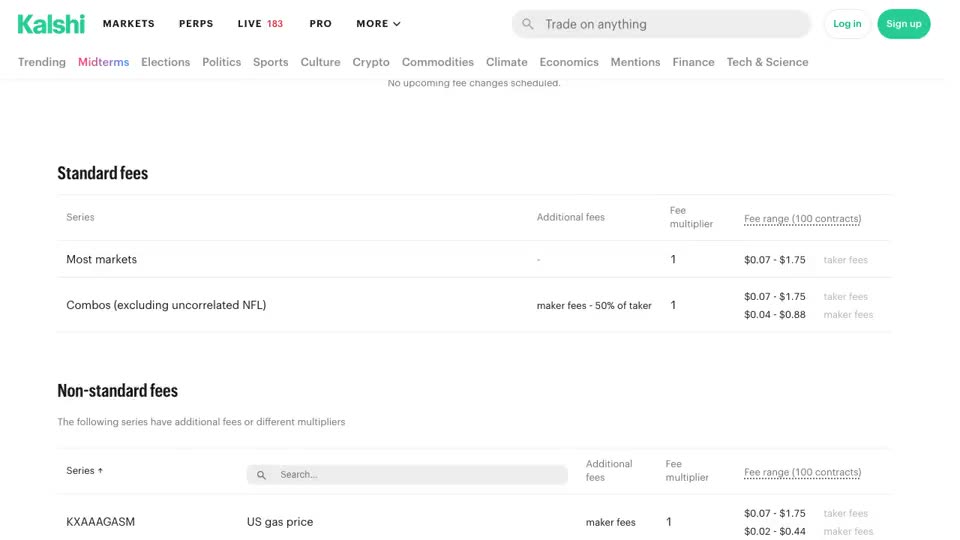
Kalshi’s public fee-schedule page: the standard fees row for most markets and the combos row, each showing a fee range per 100 contracts, then the non-standard series table with its fee multipliers and a count of total series.
Polymarket US files its fee-schedule changes with the Commission, including in weekly notifications of rule amendments. Its July 7 filing sets the current coefficient and the maker rebate:
The amendments update the Exchange-wide trading fee curve by increasing the taker fee coefficient, Theta (Θ), from 0.05 to 0.06. The Exchange’s fee formula continues to be calculated as Fee = Θ × C × p × (1 - p), where C is the number of Contracts and p is the trade price. … Taker Fee 0.05 0.06 $1.25 $1.50 Maker Rebate -0.0125 -$0.31
The two columns of dollar figures are the maximum fee at a price of $0.50, before and after the change, for 100 contracts. The maker rebate is shown as a coefficient and as a dollar maximum.
A worked example makes the two schedules comparable, with the assumptions stated so they can be changed. Assume one trade of 100 contracts at $0.50, in which one side is a taker and the other is a resting maker order, with no volume tier, no promotion and no broker fee. On Kalshi’s general schedule the taker fee is $1.75 and the maker fee is $0 under the default multiplier, so the exchange’s fee for the trade is $1.75. On Polymarket US’s schedule the taker fee is $1.50 and the maker rebate is $0.31, so the exchange’s fee net of the rebate is $1.19. These are arithmetic on two published schedules at one price. They are not either exchange’s revenue, and both schedules change by filing.
Exchanges also spend on programs. Kalshi’s referral program for its perpetual futures market shares fees with the user who referred a new customer. Its terms, filed with the Commission on July 24, 2026, set out the share:
Futures Commission Merchants and Introducing Brokers are not eligible to participate in the Program as either a Referrer or a Referee. … Each Referrer shall receive Bonus Credits equal to thirty percent (30%) of the Net Trading Fees paid by each of the Referrer’s Referees on Kalshi Perpetuals. … The Referrer Fee-Share shall be valid for a period of twelve (12) months following the applicable Referee’s registration date.
The program is for the exchange’s perpetuals market. Kalshi reserves the right to adjust the share within a stated range, and may end the program at any time.
Brokers and front ends: three ways of being paid
The customer relationship sits with a futures commission merchant, an introducing broker or a software front end, and each is paid differently. Interactive Brokers publishes its commission for event contracts in the United States:
ForecastEx Forecast Contracts Contract Type Fees ForecastEx Forecast Contracts USD 0.00 /contract Third Party Fees - Exchange Fee USD 0.01 /contract KALSHI Event Contracts Contract Type Fees KALSHI Event Contracts USD 0.01 /contract Third Party Fees - Exchange Fee USD 0.01 /contract CME Event Contracts Contract Type Fees CME Event Contracts USD 0.01 /contract Third Party Fees - Exchange Fee USD 0.01 /contract
The page lists a commission and a separate third-party exchange-fee line. It does not say how the third-party line relates to an exchange’s own schedule, and this piece does not combine them.
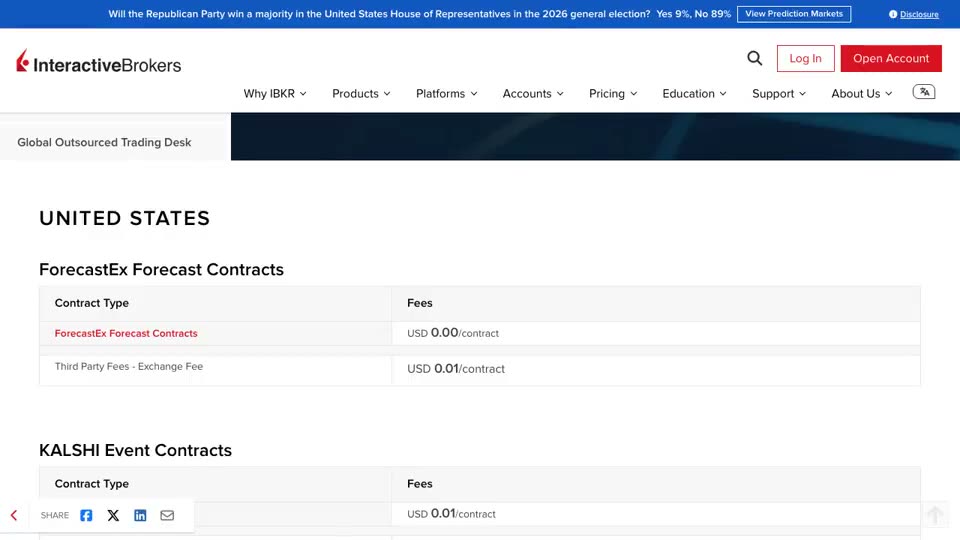
Interactive Brokers’ public commissions page for prediction markets: the United States tables for ForecastEx forecast contracts, Kalshi event contracts and CME event contracts, each with a commission and a third-party exchange fee per contract, then the disclosures under the tables.
The same filing shows what a broker’s own exchange looks like. Interactive Brokers says it set up ForecastEx and offers the contracts of other platforms alongside it:
We also offer trading in prediction markets, which are event-based contracts traded on ForecastEx, a CFTC-registered exchange and clearinghouse we established, and on other platforms.
The capital a broker must hold is set in the Commission’s regulation. A futures commission merchant needs at least $1,000,000 of adjusted net capital, and an introducing broker $45,000 or the higher amount NFA requires:
each person registered as a futures commission merchant must maintain adjusted net capital equal to or in excess of the greatest of: (A) $1,000,000, Provided, however, that if the futures commission merchant also is a swap dealer, the minimum amount shall be $20,000,000; … each person registered as an introducing broker must maintain adjusted net capital equal to or in excess of the greatest of: (A) $45,000;
An introducing broker that operates under a guarantee agreement is not subject to the introducing-broker minimum in § 1.17(a)(1)(iii), as the companion piece quotes.
An introducing broker is paid by the futures commission merchant that carries the account. DraftKings states how it recognizes that revenue, and does not state the rate:
DraftKings acts as an introducing broker, and therefore revenue is generated from introducing fees, paid by futures commission merchants, and is recognized when customer trades occur.
The filings read do not state the introducing-fee rate or the prediction-markets revenue separately from sports revenue.
A software front end that fits Staff Letter 26-25 is paid on terms the letter describes. The companion piece covers the conditions. For the economics, the letter names two sources:
which may also agree to share a specified portion of their relevant revenues with the PSP in exchange for the PSP providing this software to the Registrant’s Users. The PSP will also contract with Users (e.g., via its terms of use) to authorize them to use the software, and this agreement may provide for the PSP to charge a transaction-based fee directly to Users.
Distribution at scale: what the filings report
The largest reported number in the filings read is Robinhood’s, and it shows what a distribution layer can look like at scale. Its 10-Q reports revenue from event contracts as a separate line:
Transaction-based revenues: Options $ 265 $ 342 $ 505 $ 602 Event contracts 10 156 13 260 Cryptocurrencies 160 100 412 234 Equities 66 129 122 211 … Event contracts revenues increased primarily due to an acceleration in our prediction markets business, reflecting higher trading activity compared to the same period in 2025 when the offering was still in its early stage.
The columns are the three months and the six months ended June 30, 2025 and 2026, in millions of dollars. Robinhood reports event contracts at 12% of total net revenues for the quarter and 11% for the six months.
The same filings show the costs that sit beside that revenue. Robinhood attributes an increase in its marketing costs in part to the product:
Marketing costs increased by $5 million and $7 million for the three and six months ended June 30, 2026 primarily due to an increase in marketing expenses related to our prediction markets and credit card offerings
The filing combines the prediction-markets and credit-card offerings in this explanation and gives no separate figure for either.
Coinbase attributes a rise in one expense line largely to the exchange fees its prediction-markets business pays:
Other 37,519 7,055 30,464 432 66,045 18,986 47,059 248 … an increase in other, largely due to exchange fees associated with our prediction markets business.
Amounts are in thousands of dollars. The first two columns are the three months ended June 30, 2026 and 2025, so the line rose from about $7.1 million to about $37.5 million. The filing attributes the increase “largely” to this one cause and does not give a separate figure for it.
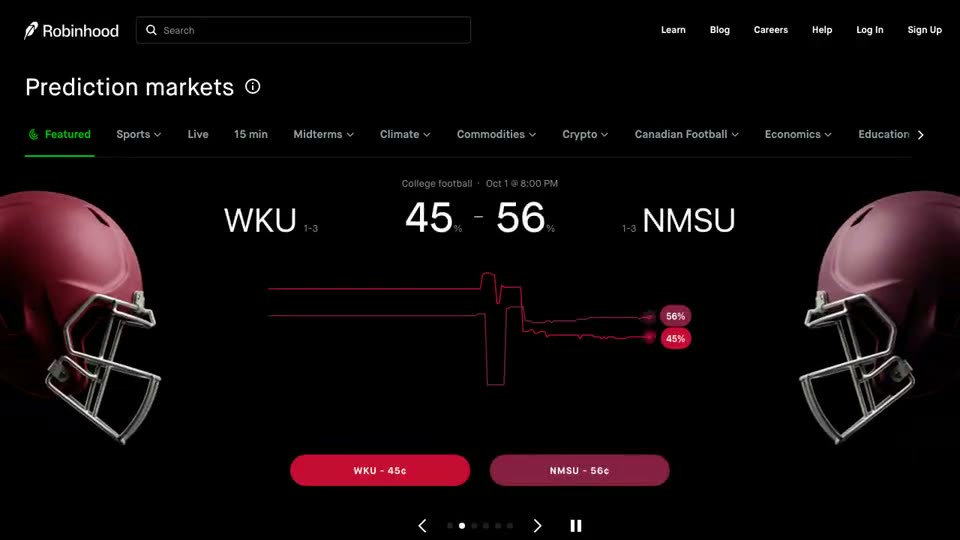
Robinhood’s public prediction-markets page with no account: a row of category tabs, a featured college football game priced in cents per side, a 2027 college basketball championship market, and boards of baseball, tennis, metals-price, MMA and entertainment contracts with percentage prices.
Market makers, data and settlement sources
Liquidity is a layer the exchanges pay for. Kalshi’s Liquidity Incentive Program, as updated in July 2026, is open to members with stated exceptions that include introducing brokers and futures commission merchants and their customers:
The purpose of this Program is to increase liquidity on the central limit order book and thereby enhance pricing efficiency. … “Eligible Participants” are all Kalshi members, except the following: (i) affiliates of Kalshi; (ii) members who have executed a Market Maker Agreement with Kalshi; (iii) Introducing Brokers, Futures Commission Merchants, and customers thereof when transacting via the IB or FCM.
The filing shows no payment amounts in the passage quoted. A market-maker business sits behind a member agreement with the exchange, and each exchange’s terms differ.
The data and settlement layer rests on a definition in the rulebooks. Each contract names the agency that publishes the number it settles to:
“Source Agency” means the agency that publishes the Underlying and/or Expiration Value for any Contract. … “Source Agency Prohibition” means the list of Source Agencies which may implicate trading prohibitions under Chapter 5 of these Rules such as if a Trader has access to material non-public information or is a decision maker.
A contract on a number published by a government agency or a league settles to that publisher. No fee for a data or oracle service appears in the records read.
Compliance tooling
The need for surveillance and location control is set by rules and by the risks the operators report. A designated contract market must monitor trading:
A designated contract market must: (a) Collect and evaluate data on individual traders' market activity on an ongoing basis in order to detect and prevent manipulation, price distortions and, where possible, disruptions of the physical-delivery or cash-settlement process; … (c) Demonstrate an effective program for conducting real-time monitoring of market conditions, price movements and volumes, in order to detect abnormalities and, when necessary, make a good-faith effort to resolve conditions that are, or threaten to be, disruptive to the market; and (d) Demonstrate the ability to comprehensively and accurately reconstruct daily trading activity
Brokers run location controls because states differ. Robinhood’s public help page describes what its system does when it detects a restricted location:
it means Robinhood has detected that you're in a location where event contract trading isn't available. This error can appear if: You're currently in a restricted state (even if you don't live there) Your state of residence on file doesn't match your current location
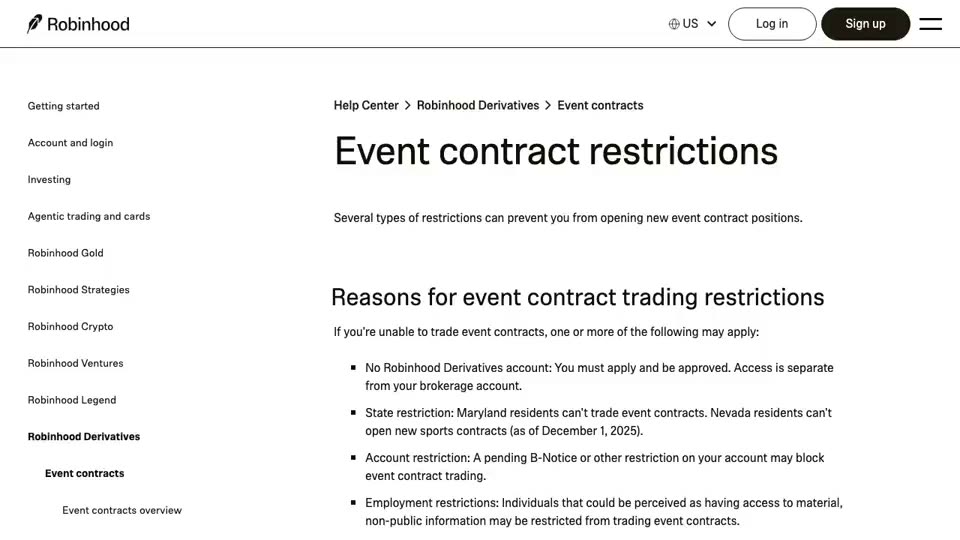
Robinhood’s public help page on event contract restrictions, scrolled from the state restriction naming Maryland and Nevada, through the position-closing-only rule applied when an eligibility or state change is detected, to the “stricter area” geolocation error and its causes.
Robinhood’s own risk factors say why the operators treat this as a core function. The filing states that its ability to offer event contracts depends on litigation and regulatory action:
Our ability to offer event contracts is subject to the outcome of currently ongoing and potential future regulatory enforcement actions and litigation, as well as potential changes in federal or state law, that could immediately or subsequently prevent us from offering, or continuing to offer, event contracts.
The records read do not price any compliance vendor, and the article names none. What they show is a standing cost for every layer above: surveillance the exchange must demonstrate, location control the broker runs, and a state-by-state map that the filings say can change.
Partnerships and white label
A company that does not build every layer has two models in the filings. In the first, an operator brings customers and technology to an exchange partner. Flutter describes its launch of FanDuel Predicts with CME Group, and CME describes the same venture from the exchange side:
Our joint venture with FanDuel, a part of Flutter Entertainment plc, launched in December 2025. This partnership introduced a new prediction markets application designed for retail customers. The application offers access to our simplified event contracts covering both major financial and economic benchmarks and sporting events.
The revenue split between the partners is not stated in the filings read.
In the second model an operator’s technology runs on someone else’s exchange. Underdog described its first arrangement in 2025:
CDNA sports event contracts will be powered by Underdog’s technology. This partnership offers American sports fans a secure, federally compliant way to access CDNA sports event contracts and make predictions on the outcomes of their favorite sports events, all within the Underdog app.
Underdog later bought its own exchange and clearinghouse, which is the build-buy-partner progression the filings show across several companies: DraftKings (an introducing broker that also bought an exchange), Robinhood (a broker that joined a venture to buy one), Interactive Brokers (a broker that established its own) and Underdog (an intermediary that bought one).
What the record shows about room for a new company
Everything below is a statement about the record, not a forecast, and each carries the condition it depends on.
- Licensed exchanges have been bought, not only built. Three buyers in the filings and releases read (DraftKings, a Robinhood venture and Underdog) acquired designated exchanges within about five months of each other, from October 2025 to March 2026. The prices that are stated range from $79 million in cash for 90% of one company to about $47 million in closing cash and equity, plus contingent consideration, for another; Underdog’s release states none. A new exchange applicant faces the 180-day review and the one-year resources test; a buyer takes an existing designation and the approvals that come with an ownership change.
- Exchange programs are written around who the participant is. Kalshi’s referral program excludes futures commission merchants and introducing brokers, and its liquidity incentive program excludes them and their customers. A company’s place in the stack decides which programs apply to it, so the registration choice is also a pricing choice.
- Broker pay is quoted per contract, in cents, and reported in aggregate in millions. Interactive Brokers lists $0.01 per contract for two exchanges’ event contracts, and Robinhood reports $260 million of event-contract revenue for the first six months of 2026. Whether a given business works at a published rate depends on its cost to acquire and serve a customer; Robinhood’s own filing says its marketing costs rose in part because of the product.
- Fees and incentives change by public filing. Polymarket US raised its taker coefficient from 0.05 to 0.06 effective July 1, 2026, and Kalshi’s programs reserve the right to amend or end them. A builder can read every change as it is filed, and the pricing they build to is not fixed.
- The filings price several layers at nothing. The records read state no fee for data or settlement services, for market-maker payments or for compliance tooling. That is a gap in the public record. It is not evidence of demand, and a company in any of these layers has to establish its own pricing.
- The costs the operators name are litigation and state action. Robinhood’s filing says its ability to offer event contracts depends on the outcome of regulatory action and litigation, and Coinbase and Robinhood both attribute rising costs, in exchange fees and in marketing, to their prediction-markets products. Any plan that depends on a state-by-state map has to carry that risk.
What a builder does with this
- Pick a layer first and a product second. The table says what each layer is registered as and how it is paid. A product that changes layers later changes its licence, its capital and its customers.
- Read the pay in the source. Use the exchanges’ own schedules and filings, dated, and re-read them before any model is built: each of the fee schedules read here is a filing or document that the exchange can change on notice.
- Price the licence before the product. For an exchange, the 180-day review and the one-year resources test are the stated figures, and the three purchases show what operators paid when they bought a licence rather than apply. For a futures commission merchant the capital minimum is $1,000,000; for an introducing broker it is $45,000 or a guarantee agreement.
- Match programs to your role. Kalshi’s referral and liquidity programs exclude introducing brokers and futures commission merchants. Decide whether the business is a broker, a member or a software provider before building a revenue model on an exchange’s program.
- Model with labelled assumptions and published figures only. The worked example in this piece shows the form: one trade, stated prices, stated fees and no volume tier. Replace the assumptions with your own, and keep every figure traceable to a filing.
- Build a state map into the product on day one. Brokers in the filings run location controls and state restrictions, and the risk factors say the map can change. Treat location control and surveillance as part of the cost of every layer.
- Where the record is silent, say so in your own plan: data, settlement, market making and compliance tooling have no published prices in the records read. Interview the exchanges and brokers that would buy the service before the pricing goes in a model.
- Pair this piece with the companion on building on the Phantom letter if the business is a front end, and with the prediction-markets enforcement pieces before choosing which states to serve.