Online casinos and sportsbooks · Brief · 6 min read
Online casinos and sportsbooks: where responsible-gaming rules have been enforced
Five regulator-published records of fines for self-exclusion and responsible-gaming failures: three New Jersey Division of Gaming Enforcement documents and two Pennsylvania Gaming Control Board releases, quoted, with the rules they cite.
The responsible-gaming rules read in the state-by-state brief of this series have been enforced against licensed operators. This brief reads the records that two regulators publish: three New Jersey Division of Gaming Enforcement documents and two Pennsylvania Gaming Control Board releases. It states what each document says and what the rule it cites requires. Records from other states were searched for and not found, so the brief covers two states and says nothing about the rest.
New Jersey: orders adopting actions in lieu of complaint
The largest of the three is the August 2026 order against Caesars Sportsbook. It adopts an action in lieu of complaint and lists the rules the operator did not comply with:
It is hereby ORDERED that the Action in Lieu of Complaint dated August 5, 2026 and issued by the Division of Gaming Enforcement (“Division”) to Caesars Sportsbook regarding responsible gaming matters concerning non-compliance with N.J.A.C. 13:69C-14.2(b), N.J.A.C. 13:69C-14.2(c), N.J.A.C. 13:69G-2.2, N.J.A.C. 13:69G-2.3, and N.J.A.C.13:69G-2.4 is hereby adopted; It is further ORDERED that the Division imposes a civil penalty in the amount of $251,250, with an additional disgorgement of $45,465.38 upon Caesars Sportsbook, which penalty has been accepted by Caesars Sportsbook.
The order does not describe the conduct. The rules it cites are the advertising and signage rule (13:69C-14.2(b) and (c)) and the self-exclusion rules (13:69G-2.2, 2.3 and 2.4), which the state-by-state brief quotes.
The October 2025 order against Digital Gaming Corporation states its subject in one clause and adds a disgorgement:
It is hereby ORDERED that the Action in Lieu of Complaint dated October 14, 2025 and issued by the Division of Gaming Enforcement (“Division”) to Digital Gaming Corporation (“DGC”) regarding various violations pertaining the self-excluded individuals and responsible gaming limits is hereby adopted; It is further ORDERED that the Division imposes a civil penalty in the amount of $112,188.96 upon DGC, and a disgorgement of $5,278.73, which amounts have been accepted by DGC.
The Division’s June 2026 letter to Bally’s Interactive is the one document of the three that sets out the conduct, which was one incident in August 2023:
The Division of Gaming Enforcement (“Division”) brings this Action in Lieu of Complaint against Bally’s Interactive LLC d/b/a Bally’s Interactive (“Bally’s Interactive”) concerning its non compliance with N.J.A.C. 13:69G-2.4(a)(2) in August 2023, when it did not prevent self-excluded patrons from wagering. After identifying the error, Bally’s Interactive blocked the associated self-excluded accounts and updated its software to prevent the recurrence of similar errors. … the Division accepts the offer of Bally’s Interactive to render a civil monetary penalty in the total amount of $7,050. While the Division agrees that it will not institute further regulatory action beyond this Action in Lieu of Complaint based on the above-described matter, any additional violations of N.J.A.C. 13:69G-2.4(a)(2), no matter how de minimis, will result in further disciplinary action by the Division.
The rule Bally’s letter cites has two relevant parts: refuse wagers from a self-excluded person, and keep promotional materials away from them.
2. Refuse wagers from and deny any gaming privileges to any self-excluded person; … (b) For Internet self-excluded patrons, a casino licensee shall establish procedures that are designed, to the greatest extent practicable, to: 1. Ensure that self-excluded persons do not receive, either from the casino licensee or any agent thereof, junket solicitations, targeted mailings, telemarketing promotions, player club materials, or other promotional materials relating to Internet gaming
Paragraph (a) is written for a casino and its facility; the Division’s letter to Bally’s Interactive applies its paragraph (a)(2) to online wagering.
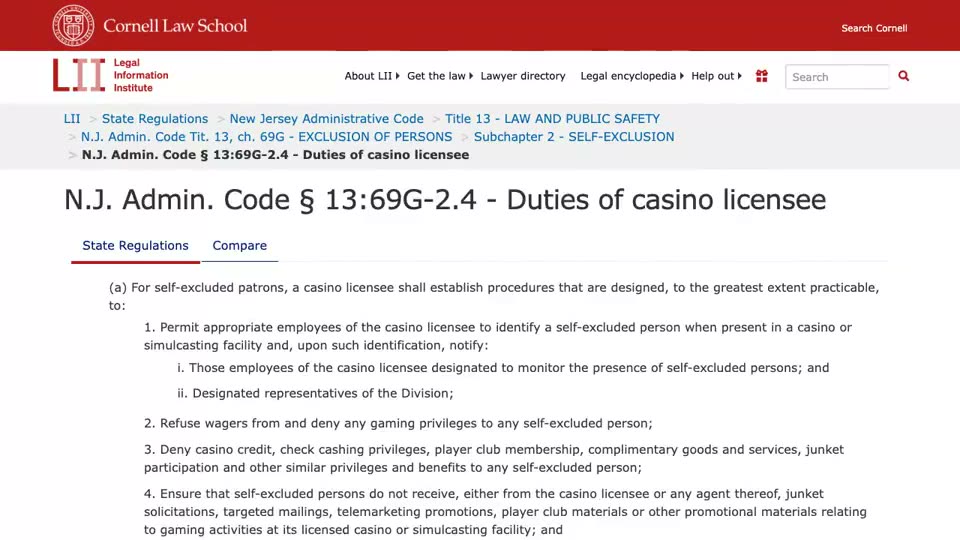
Cornell’s public copy of N.J.A.C. 13:69G-2.4, the self-exclusion duties the Division’s orders cite: the casino procedures in paragraph (a), including “Refuse wagers from and deny any gaming privileges to any self-excluded person”, and the internet procedures in paragraph (b).
Pennsylvania: consent agreements approved at a public meeting
The Gaming Control Board announces consent agreements after each monthly meeting. In January 2025 its largest fine was against an interactive gaming operator for people on the interactive self-exclusion list:
The largest of the fines is $260,905 and was assessed against Interactive Gaming Operator BetMGM, LLC for 152 instances in which an individual on the Board’s Interactive Self-Exclusion List was permitted to gamble on their sites. Licensed operators of iGaming sites in Pennsylvania must deny individuals on the self-exclusion list from establishing or maintaining an interactive gaming site. … Copies of any of the approved Consent Agreements containing additional details are available upon request through the Board’s Office of Communications.
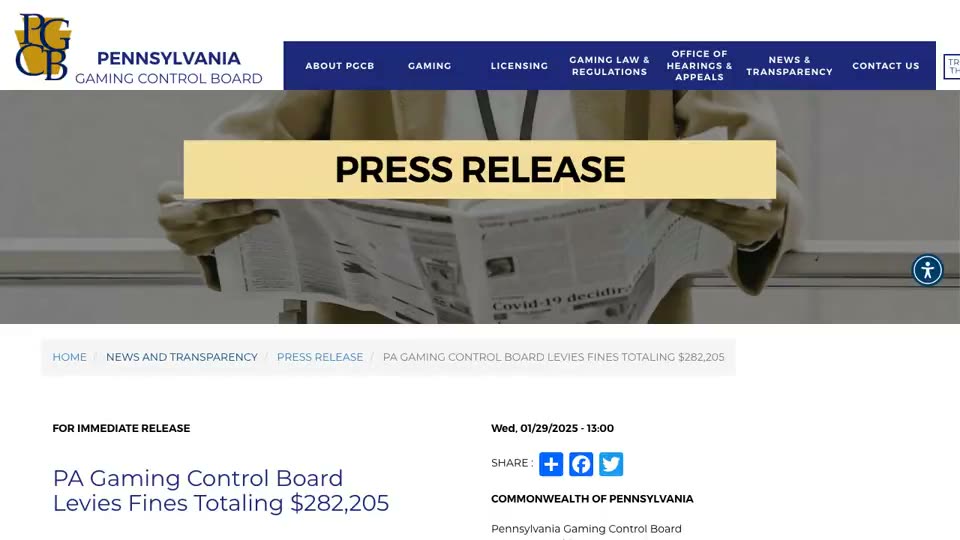
The Pennsylvania Gaming Control Board’s public press release of January 29, 2025: the three consent agreements approved at the meeting, with the largest fine against an interactive gaming operator for 152 instances involving the Interactive Self-Exclusion List.
The Board’s casino-floor matters follow the same pattern. In February 2026 a land-based casino received a fine for admitting self-excluded individuals:
Holding Acquisition Co., L.P., operator of Rivers Casino Pittsburgh, a $70,000 fine for seven instances of permitting self-excluded individuals to gain access to their casino floor and gamble
A land-based casino matter, quoted for comparison with the online matter above.
What the records have in common
- Each is a settlement. New Jersey’s are orders adopting an action in lieu of complaint that the operator accepted; Pennsylvania’s are consent agreements approved at a public meeting. None is a finding after a contested hearing.
- Self-exclusion is the subject of each online matter read: patrons who should have been blocked were able to wager (Bally’s, in August 2023; BetMGM, 152 instances; Digital Gaming Corporation’s order names self-excluded individuals and limits).
- Money moves two ways in New Jersey. Orders #3070 and #2890 each add a disgorgement to the penalty.
- The remedy the one detailed document records is operational. Bally’s blocked the accounts and updated its software.
- Repeat violations are expressly watched in the one document that says so. The Bally’s letter says the Division will take no further action on the matter, and that any additional violation of the same rule, “no matter how de minimis”, will draw discipline.
A checklist drawn from the records
- Test the block on a self-excluded account end to end. The one fully described New Jersey incident is a failure to refuse wagers (13:69G-2.4(a)(2)).
- Keep the list current within the rule’s deadlines. New Jersey’s rule gives an internet list 24 hours; the Caesars order cites the list rules (13:69G-2.3).
- Know which channel a rule assigns. New Jersey’s rule requires a request for lifetime internet self-exclusion to be made in person (13:69G-2.2(c)), and the Caesars order cites that section among others.
- Check signage and advertising wording against the rule. The Caesars order cites 13:69C-14.2(b) and (c), which set the required phrases.
- Test player limits as the regulator would. The Digital Gaming Corporation order names responsible gaming limits among its subjects.
- When an error is found, fix it and say so. Bally’s blocked the accounts and updated its software, and the Division’s letter records both.
- Expect disgorgement beside a penalty, as in both of the larger New Jersey orders, and keep the records that would show the amount.