Online casinos and sportsbooks · Brief · 6 min read
Online casinos and sportsbooks: the B2B opportunity in a regulated market
What licensed operators say they buy from suppliers, how one supplier reports being paid, what a supplier licence costs and requires in two states, and where the record shows room for a new company.
A licensed online casino or sportsbook buys a good deal from other companies. This brief reads what two operators say they buy, how a listed supplier reports being paid, what a supplier licence costs and asks in two states, and which layers the record leaves for a new company. It states no supplier’s revenue other than one segment of one company, because no other was read, and it forecasts nothing.
What operators say they buy
Rush Street Interactive’s annual report lists what drives its third-party platform and content fees, and separately its payment costs:
Our third-party platform and content fees are primarily driven by costs associated with third-party casino content, data and streaming, sports betting … trading services, geolocation, know-your-customer and platform hosting. … We incur payment processing costs on player deposits, withdrawals and occasionally chargebacks
The two parts of the first sentence are separated by a page break in the filing.
PENN Entertainment’s risk factors list the services it calls essential to its online sportsbook and casino business:
We rely on third parties to provide services that are essential to the operation of our OSB and iCasino business, including geolocation, identity and age verification, payment processing, and sports data.
Some operators build a layer themselves. Rush Street says it built responsible-gaming controls into its own platform:
We have built our online platform to meet the needs of differing regulatory regimes, including configurable regulatory and responsible gaming controls such as operator alerts on customer behavior, deposit limits, betting limits, loss limits, cooling-off periods and session limits.
How one supplier reports being paid
Light & Wonder’s iGaming segment supplies casino content, aggregation platforms and a player account system to operators. Its annual report states how the revenue arises and what it was:
iGaming revenue is generated from various games made available via our aggregation platforms, remote gaming servers and various other platforms, which deliver a wide spectrum of internally developed and branded games and popular third-party provided games to gaming operators. iGaming revenue is also generated from platform technology solutions, which provide gaming operators optional portals for reporting and administrative functions. We provide daily access to these platforms and are typically compensated based on variable consideration, such as a percentage of net gaming revenue with variability generally resolved in the reporting period.
Overall, iGaming revenue increased by $38 million, or 13%, as a result of the strength of our original content, continuing momentum in the North American market underpinned by 1PP growth and the expansion of our partner network. Wagers processed through our Open Gaming System increased to $109 billion for the year ended December 31, 2025, an $18 billion increase from the prior year.
The company’s segment revenue was $337 million in 2025, $299 million in 2024 and $275 million in 2023 (the filing’s revenue table).
Michigan: what a supplier licence costs
Michigan requires a licence for anyone who provides goods, software or services to an internet gaming operator, and prices it:
A person that is not licensed under this section shall not provide goods, software, or services as an internet gaming supplier to an internet gaming operator. … An internet gaming supplier license issued under subsection (1) is valid for the 5-year period after the date of issuance. … An application under this section must be accompanied by a nonrefundable application fee in an amount to be determined by the board, not to exceed $5,000.00. The board may assess additional fees for the cost related to the licensure investigation. … An internet gaming supplier shall pay a license fee of $5,000.00 to the board at the time an initial internet gaming supplier license is issued to the internet gaming supplier and $2,500.00 each year after the initial license is issued.
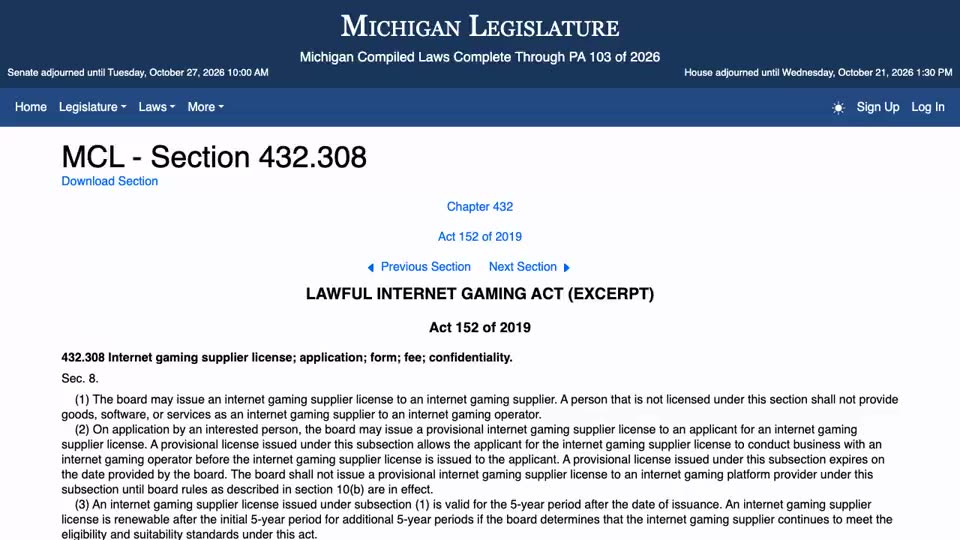
The Michigan Legislature’s public text of MCL 432.308: the licence requirement, the provisional licence, the five-year term, the application fee cap and the licence fees.
Pennsylvania: how suppliers are classified
Pennsylvania’s section on gaming service providers to slot machine licensees sorts suppliers by the value of their business and by access:
(a) Development of classification system.-- The board shall develop a classification system governing the certification, registration and regulation of gaming service providers and individuals and entities associated with them. The classification system shall be based upon the following: (1) The monetary value or amount of business conducted or expected to be conducted by the gaming service provider with an applicant for a slot machine license or a slot machine licensee in any consecutive 12-month period. (2) Whether the employees of the gaming service provider will have access to the gaming floor or any gaming-related restricted area of a licensed facility. … (2) Develop and maintain a list of prohibited gaming service providers.
This section concerns suppliers to slot machine licensees. Pennsylvania’s interactive-gaming supplier provisions were not read.
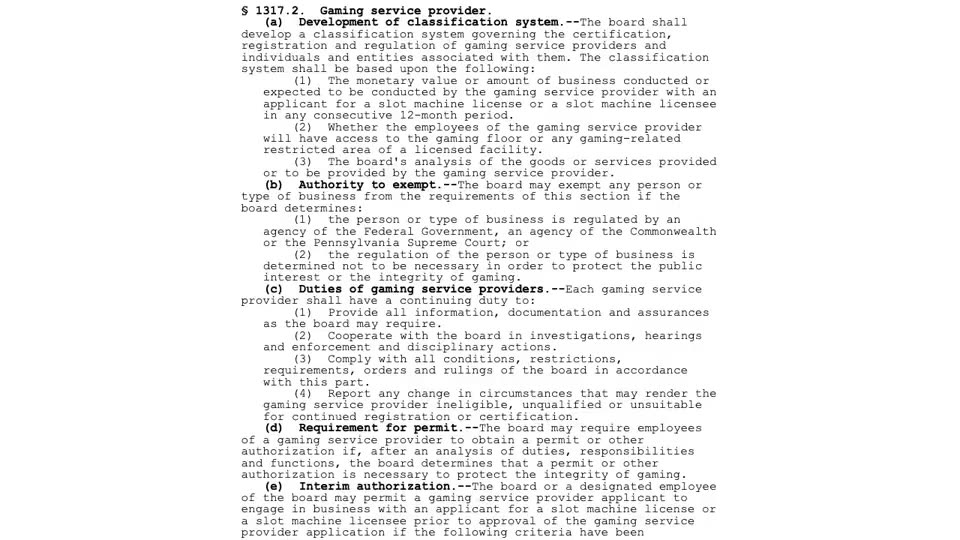
The Pennsylvania General Assembly’s public text of 4 Pa.C.S. § 1317.2: the classification system for gaming service providers, the board’s authority to exempt, a provider’s continuing duties, interim authorization and the lists of approved and prohibited providers.
The lines, and what the record shows about room
| Line | Who buys it | How the record says it is paid | What the documents say about it |
|---|---|---|---|
| Casino content and aggregation | Operators | A percentage of net gaming revenue (Light & Wonder) | Michigan’s licence covers goods, software or services supplied to an operator |
| Player account and platform technology | Operators | Same, for platform technology solutions (Light & Wonder); platform hosting is a fee line (Rush Street) | Michigan’s licence; Rush Street also builds platform controls itself |
| Geolocation and identity checks | Operators | A cost within platform and content fees (Rush Street); named as an essential service (PENN) | Not named in the two licence texts read |
| Payments | Operators | A processing cost on deposits, withdrawals and chargebacks (Rush Street) | Not named in the two licence texts read |
| Data and trading services | Operators | A cost within platform and content fees (Rush Street); sports data (PENN) | Not named in the two licence texts read |
| Responsible-gaming tooling | Operators | Not stated in the filings read; Rush Street describes building its own | The rules in the state-by-state brief set what the tools must do |
Three things in the record bear on a new entrant. Operators name the layers they buy and, in the filings read, name no vendors. One supplier reports revenue growth of 13% in one segment, paid as a share of operators’ net gaming revenue. And Michigan’s licence is priced in thousands of dollars, with a provisional route, so cost to enter is stated in the statute rather than left open. None of this says a layer is uncrowded or that a licence will be granted.
A checklist for a company that wants to sell to licensed operators
- Pick the layer from what operators say they buy: content, platform, geolocation and identity checks, payments, data, or responsible-gaming tooling.
- Ask how the layer is paid. The one supplier read is paid a share of net gaming revenue, which ties its income to the operator’s results.
- Read the state’s supplier statute before the first customer. Michigan requires a licence for goods, software or services to an operator, and its provisional licence lets an applicant do business before the licence issues.
- Price the licence in the state. Michigan states a $5,000 cap on the application fee, a $5,000 licence fee and $2,500 a year after the first, and lets the board assess investigation costs.
- For a responsible-gaming product, build to the strictest text in the states you sell to, and keep the list and limit logic auditable. The enforcement brief shows what regulators have fined.
- Expect operators to build some layers themselves. Rush Street says it built its own controls.
- Check each statute and filing on the day you plan. The sources here are dated 2026-10-16.