Online casinos and sportsbooks · Brief · 8 min read
Online casinos and sportsbooks: responsible-gaming rules, state by state
What six states’ regulations tell a licensed online casino or sportsbook to offer a player: limits, self-exclusion, pauses and marketing. Quoted from New Jersey, Pennsylvania, Michigan, New York, Illinois and Ohio, with a table that says where a rule was not read.
A licensed online casino or sportsbook is told by its regulator what responsible-gaming tools to offer, and the states say it in different words. This brief reads six states’ rules on four points: limits a player can set, self-exclusion, pauses, and marketing to people who have used those tools. The table says where a state’s text was not read, and the differences are between those texts, not a ranking.
| State | Limits the platform must offer | Self-exclusion | Marketing to those who used the tools |
|---|---|---|---|
| New Jersey (internet gaming) | Deposit, spend (daily, weekly, monthly) and a daily time limit; a pause of at least 72 hours | One year, five years or lifetime; lifetime requested in person | Not to receive promotional materials if on the Internet list |
| Pennsylvania (interactive gaming) | Deposit, loss, single-wager, time and table limits; a pause of at least 72 hours | Casino self-exclusion: one year, five years or lifetime; the online rule was not read | Not read |
| Michigan (internet gaming) | An easy and obvious method for deposits, wagers and time | Operator list; request through the account | List may be used only to remove names from marketing |
| New York (mobile sports wagering) | Self-imposed limits must be available, with a responsible-play page and an annual plan | Parts 5325 and 5327 apply; not read | Not read |
| Illinois (sports wagering) | Wager amount, new deposits or all wagering, for 72 hours to one year | Board list; no wagers; accounts suspended | No marketing to a patron with a limit or on the list |
| Ohio (sports gaming) | Deposits, wagers and time, with an automatically renewing option | Not quoted in this brief | Advertising rule in 3775-16-08 (see the prediction-markets brief) |
Limits: what the platform must offer
New Jersey names three limits, asymmetric in timing: a decrease is effective at the next login, and an increase only after the previous period expires.
(n) An Internet or mobile gaming system shall be capable of allowing a patron to establish the following responsible gaming limits. Any decrease to these limits shall be effective no later than the patron's next log in. Any increase to these limits shall become effective only after the time period of the previous limit has expired. 1. A deposit limit shall be offered on a daily, weekly, and monthly basis … 2. A spend limit shall be offered on a daily, weekly, and monthly basis … 3. A time-based limit shall be offered on a daily basis
Pennsylvania lists five limits and a pause, and adds a reaffirmation step for an increase:
Any increase to these limits must become effective only after the time period of the previous limit has expired and the registered player reaffirms the requested increase: (1) A deposit limit must be offered on a daily, weekly and monthly basis … (3) A limit on the maximum amount of any single wager on any interactive game. … (6) A temporary suspension of a player’s interactive gaming account must be offered for any number of hours or days, as selected by the registered player, which shall not be less than 72 hours.
Michigan and Ohio use the same opening words, “an easy and obvious method”, and differ on how a limit can be loosened:
Authorized participants must be provided with an easy and obvious method to impose limitations for internet wagering parameters including, but not limited to, deposits, wagers, and time-based limitations. … (c) Once established by an authorized participant and implemented by the internet gaming platform, it must only be possible to reduce the severity of self-imposed limitations upon 24 hours’ notice, or as required by the board.
(c) Once established by a patron and implemented by the sports gaming system, it must only be possible to reduce the severity of self-imposed limitations upon the expiration of the self-imposed period; and (d) An option must be available for patrons to set automatically renewing self-imposed limits
Illinois sets a floor and a ceiling on the length of a limit, bars lifting it early, and makes the platform notify the patron when it ends:
b) The internet wagering system must allow a patron to implement prohibitions including, at minimum, prohibitions on: 1) Dollar amount of wager; 2) Prohibiting new deposits; or 3) All wagering. c) Patrons shall be permitted to determine the length of time of the limitation, but no limitation shall be imposed for less than 72 hours or greater than one year. d) Limitations or restrictions imposed under this Section shall not be lifted prior to their expiration.
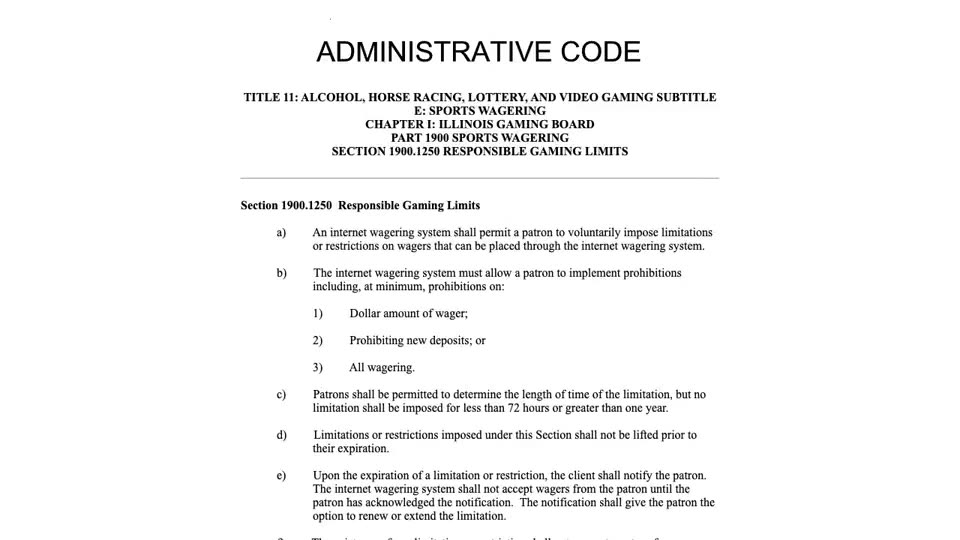
The Illinois General Assembly’s public text of Section 1900.1250, “Responsible Gaming Limits”: the prohibitions a patron can impose, the 72-hour minimum and one-year maximum, the notice on expiry and the bar on direct marketing to a patron with a limit.
Self-exclusion: who keeps the list and what the operator does
New Jersey’s Division keeps the lists and sets the periods. A lifetime exclusion from internet gaming is requested in person, and the operator’s copy of the internet list has a short deadline:
Notwithstanding the above, if a person requests to be placed on the Internet self-exclusion list for life such request shall be made in person at a location designated by the Division.
The same section lists the lengths of exclusion a request may state: one year, five years or lifetime.
For the Internet self-exclusion list, changes shall be made within 24 hours after the notice is transmitted pursuant to (a) above. … (e) For Internet self-exclusion, any open wagers shall be voided within three days of the notice of self-exclusion. Any remaining balance of $ 1.00 or more in a patron's Internet gaming account balance shall be refunded no later than 90 days after the notice of self-exclusion.
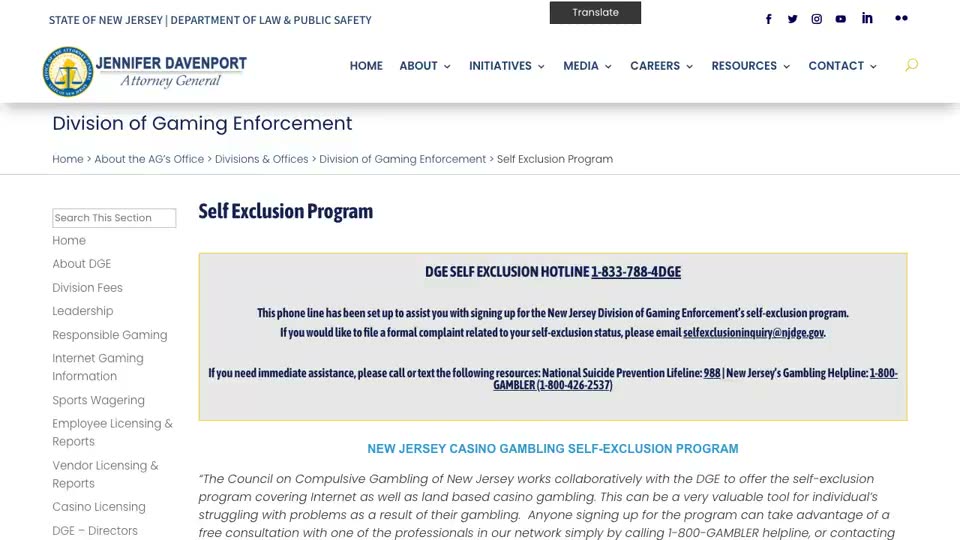
The New Jersey Division of Gaming Enforcement’s public Self Exclusion Program page: the four ways to register (in person or video, online, or through an online player account) and the minimum periods of one year, five years or lifetime for each.
Illinois adds duties for the operator once a person is on the list: no marketing, a detection system, no new account, suspension of an existing account, voided wagers and a refund of the balance.
b) A master sports wagering licensee shall not send marketing or promotional materials to any person placed on the Self-Exclusion List. … h) For any master sports wagering licensee that conducts internet wagering: 1) The licensee shall not allow an individual on the Self-Exclusion List to open a new sports wagering account; 2) The licensee shall identify and suspend any sports wagering account of any individual on the Self-Exclusion List; 3) The licensee shall void all outstanding wagers in accordance with Section 1900.1740; and 4) The licensee shall refund any remaining balance to the patron in a manner consistent with the licensee's internal control system.
Pennsylvania’s casino self-exclusion rule states the same three lengths, in the request a person files with the Board:
(d) The length of casino self-exclusion requested by a person must be one of the following: (1) One year (12 months). (2) Five years. (3) Lifetime.
This is the casino self-exclusion rule. The interactive-gaming self-exclusion provisions were not read.
Marketing and disclosure
Michigan lets an operator pass its self-exclusion list to a licensed marketing vendor for one purpose:
A licensed or registered third-party that obtains the self-exclusion list from an internet gaming operator or internet gaming platform provider is permitted to use the list solely to exclude names and other information from targeted mailings or other advertising or promotion made on behalf of the internet gaming operator or internet gaming platform provider.
New Jersey requires a helpline message on the log-on screen and set words in print advertising, and New York requires a responsible-play page, an annual plan and compliance with its self-exclusion parts:
(b) Any on-site advertising of casino or casino simulcasting facility operations shall contain the phrase "Bet With Your Head, Not Over It," or some comparable language approved by the Division. (c) All advertising which appears in print, or on a billboard or sign shall contain the words "If you or someone you know has a gambling problem and wants help, call 1-800-GAMBLER" or some comparable language approved by the Division
(a) Publicly accessible internet page. A skin shall maintain a publicly accessible internet page dedicated to responsible play … (b) Problem-gaming plan. A skin shall submit annually on or before September 1 st to the commission for approval … a problem-gaming plan … (c) Other regulatory requirements . Each skin shall comply with the problem gaming, selfexclusion and excluded person requirements, including trainings, set forth in Parts 5325 and 5327 of this subchapter as if such licensee were a gaming facility licensee and with Part 5402 of this subtitle.
Parts 5325, 5327 and 5402 were not read for this brief.
What one operator says it offers
Rush Street Interactive, which operates online casinos and sportsbooks in several of these states, describes its tools in its annual report. It is the operator’s own description, not a rule:
These practices, resources and services include deposit limits, voluntary restrictions on access and use of certain offerings, temporary self-exclusion and cooling-off periods, voluntary permanent exclusion from our offerings and applications and data science technology, which helps us flag any suspicious, abnormal or problematic betting activity. … We also maintain a self-excluded customer list, which prohibits self-identified customers from placing bets or participating in real-money gaming and have embedded the software to limit or restrict the amount individual customers spend.
The operator’s statement in its annual report. This brief does not say which state’s rules each tool answers.
What a builder does with this
- Build limits to the strictest text you are subject to. Illinois bars lifting a limit before it expires and Ohio allows loosening only at expiry; Michigan allows it on 24 hours’ notice and New Jersey after the prior period ends.
- Treat self-exclusion as a data flow. The operator’s copy of a list, the 24-hour update in New Jersey, the account suspension and refund in Illinois and the marketing suppression in Michigan and Illinois all depend on one list reaching every system.
- Keep a state module. The helpline wording, pause lengths and limit types differ by state, so the product holds each state’s words as configuration.
- Read the rule behind each cross-reference. New York’s text points to Parts 5325, 5327 and 5402, and this brief did not read them; the table’s “not read” cells are gaps to fill, not rules that do not exist.
- Check each text on the day you build. The sections above are dated 2026-10-16, and New Jersey, Illinois and New York each have proposals pending.