Loot boxes and skins · Brief · 7 min read
Mystery card packs and box breaks: the structures and their economics
Five ways platforms’ own rules let randomized cards be sold online, what each tells the buyer in advance, and what a break costs the seller in published fees, with one worked example whose assumptions are labelled.
There are several ways to sell randomized trading cards online, and the platforms that host them write the structure into their rules. This brief reads five of them in eBay’s and Whatnot’s own words, says what each tells a buyer before the purchase, and works out what a break costs the seller in the fees the two platforms publish. It states no company’s revenue or margin, because none was found in a filing, and it does not call any structure safe.
Five structures in the platforms’ rules
| Structure | What the buyer is told before paying | What the platform rule reads |
|---|---|---|
| A break of factory-sealed product | The rules of the break, including how base and bulk cards are handled | Whatnot: rules in the show notes or listing, no prize, a card for every buyer. eBay: pre-approved sellers only, and the buyer receives the pack, box or slot bought |
| A break with a free entry | That no purchase is necessary and a sweepstakes accompanies each break | eBay’s breaks page |
| A surprise set | A full checklist of the items in the set, before the sale | Whatnot: each purchase corresponds to an item on the list; no floor, ceiling or average may be stated |
| A mystery box or grab bag | General information about what is included | eBay: items of monetary or collector’s value may not be singled out unless every purchase includes them |
| Manufacturer-sealed surprise product | A published checklist for the series | Whatnot: only products on its identified list may be sold, and the list requires a complete checklist |
The mystery box with stated chances and a floor, as POP MART and Courtyard describe it, is covered in the promotions brief of this series and is not repeated here.
One statute turns on the difference between the first and last rows. California’s grab-bag section defines its package by where the cards came from:
“Sports trading card grab bag” means a sealed package which contains one or more sports trading cards that have been removed from the manufacturer’s original packaging.
The brief on card breaks in this series quotes the whole section. This one text is why a manufacturer-sealed product and a repack are listed as different structures.
What each structure tells the buyer in advance
Whatnot’s surprise-set rule makes the list the structure: the seller lists what is available, and each purchase corresponds to an item on the list.
Surprise Set is a sale format where a curated group of items is split among multiple buyers. Sellers list what items are available before the sale, and each purchase corresponds to an item from the list. … Full detailed list required: In the listing description sellers must provide a full detailed checklist of all the items in each Surprise Product within each Set. … No prize: Sellers cannot include a prize in their Surprise Set. Sellers also cannot provide or describe the floor, ceiling, or average of the items in their Set.
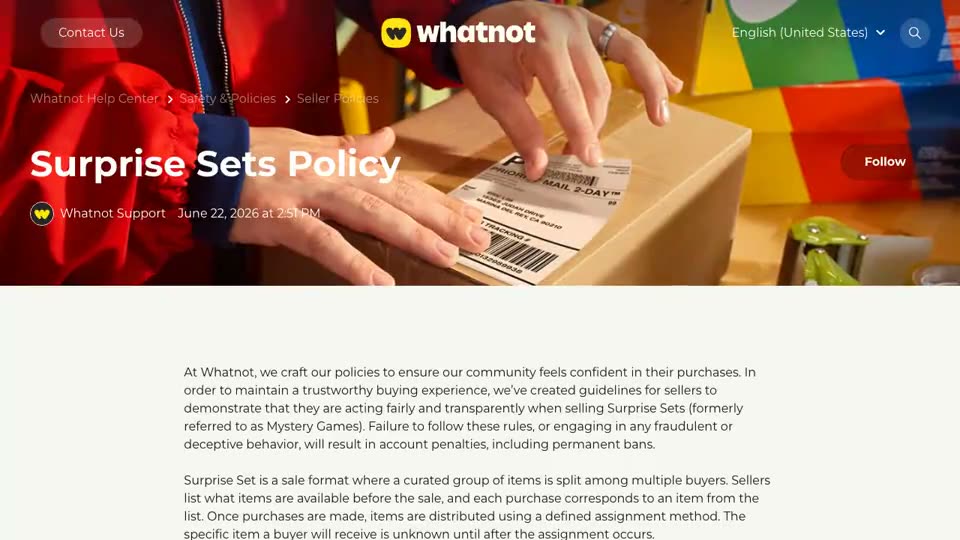
Whatnot’s public Surprise Sets Policy, dated June 22, 2026: the definition of a surprise set, then the randomization and visibility rules, the full detailed list requirement with its example listing, and the “No prize” rule.
For manufacturer-sealed product, Whatnot goes one step earlier and requires the series to be on its list, which asks for a complete checklist:
Professionally Sealed Surprise Products not on this List cannot be sold, used in Card Breaks or Surprise Sets, or given away on Whatnot. … Whether the Professionally Sealed Surprise Products include a complete checklist that accurately describes the items offered.
eBay’s rule for mystery boxes and grab bags asks for general information and bars singling out the valuable items unless every purchase includes them:
Grab bags or mystery boxes may be listed under the following conditions: The listing contains general information about what is included The listing does not single out items with monetary or collector's value unless they are included with every purchase
What a guarantee can say
Whatnot’s gambling policy bars rewards that depend on an outcome but allows a reward that every buyer is told about and receives:
Follower-only giveaways or other games that do not require a purchase or payment are permitted. Additionally, specific and disclosed rewards that are guaranteed upon purchase are permitted.
The same policy lists a break with pre-defined guarantees that apply only to certain assignments as prohibited. The line the policy draws is between a reward every purchase carries and one tied to an outcome.
eBay’s breaks page ties price to the contents and says how a spot is priced:
The prices for spots in a break are typically determined by the breaker, taking into account factors like the cost of the product being opened, the popularity of the teams or players involved, and the potential value of the cards that could be pulled from the break.
What a break costs the seller: the published fees
Whatnot publishes a commission by category and a four-week sales tier. For U.S. sports and trading-card sales the standard tier is 8.00% and the top tier 6.50%, on the item price, with payment processing on top:
Sports 8.00% 7.75% 7.50% 7.25% 7.00% 6.75% 6.50% … Whatnot calculates commission on Gross Merchandise Value (GMV), which is the sale price of the item. Shipping and taxes paid by the buyer are not included. … Payment processing fees vary by market: US, Canada, Australia: 2.9% + $0.30 per transaction
The columns run from the standard tier ($0–$14,999 in four weeks) to the top tier ($500,000 and up).
eBay treats every case-break purchase as an eBay Live transaction, with a 6% commission capped at $100 per item for categories other than coins, bullion and sneakers, plus payment processing:
All case break purchases or commitments to purchase, even when made outside of an event, are considered eBay Live transactions. … All other categories: 8.9% (6% + 2.9%) on the first $1,667 (6% x $1,667 = $100 cap on the commission fee) of the sale then 2.9% on the portion over $1,667 plus $0.30 per order fee
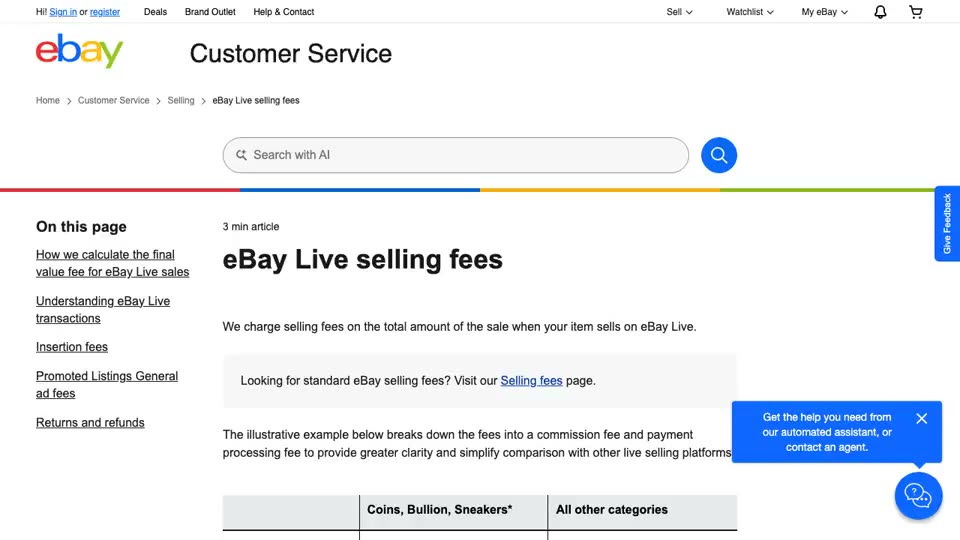
eBay’s public “eBay Live selling fees” page: the table of commission and payment-processing fees by category, the promotion note, and the start of the section on how the final value fee is calculated. A site assistant prompt appears at the right.
A worked example, with assumptions that are ours and not any seller’s: a break of 30 spots at $50 each, $1,500 in all; no shipping or tax collected; the Whatnot standard tier; the eBay rate for “all other categories”. The arithmetic is on each platform’s published rates:
| Per $50 spot | Whatnot (standard tier) | eBay Live (all other categories) |
|---|---|---|
| Commission | 8% × $50 = $4.00 | 6% × $50 = $3.00 (under the $100 cap) |
| Payment processing | 2.9% × $50 + $0.30 = $1.75 | 2.9% × $50 + $0.30 = $1.75 |
| Fees per spot | $5.75 (11.5% of the spot price) | $4.75 (9.5%) |
| Fees on 30 spots | $172.50 | $142.50 |
| Left before the cost of the cards and shipping | $1,327.50 | $1,357.50 |
The fees are one line. The cost of the sealed product and of shipping a card to each buyer, which the platforms’ rules require, come out of the same amount, and neither platform’s page states them. Whatnot’s top tier lowers its commission by 1.5 points from the standard tier, and eBay’s cap matters only above $1,667 per item.
A checklist for a seller or a platform builder
- Decide what defines the product: the listed contents (a surprise set), the sealed series and its checklist (a manufacturer product), or the spot (a break).
- Publish the list or the break rules before the sale. Whatnot requires the checklist or rules in the listing or show notes; eBay asks for general information on a mystery box.
- Do not state a floor, ceiling or average for a surprise set on Whatnot, and do not single out valuable items on eBay unless every purchase includes them.
- Tie any guarantee to the purchase, not to an outcome. Whatnot permits a specific, disclosed reward guaranteed upon purchase and lists outcome-tied guarantees as prohibited.
- Add a free entry where the platform’s model uses one. eBay attaches a no-purchase sweepstakes to each break.
- Price the break from published fees, then subtract the cost of the cards and of shipping to every buyer.
- Re-read the fee pages on the day you launch. Whatnot’s commission structure changed on September 21, 2026, and eBay’s Live page carries a promotion that ends December 31, 2026.