Loot boxes and skins · Brief · 6 min read
Gacha odds disclosure: what app stores, the FTC, Korea and China require
What a game must disclose about randomized items, and where, under the Apple and Google store rules, an FTC order, Korea’s enforcement decree and a 2016 Chinese ministry notice, with one publisher’s disclosure as an example.
A game that sells randomized items answers two questions in every market it enters: what must be disclosed about the odds, and where must the disclosure sit? This brief reads the answers in the Apple and Google store rules, an FTC order, a Korean enforcement decree and a 2016 Chinese ministry notice, and shows one publisher’s live disclosure. It leaves out Japan and the U.S. industry’s 2019 commitment, for the reasons in the review notes, and it does not say that any game complies with any of these.
The two store rules
Apple’s guideline on payments requires the odds of each type of item before purchase:
Apps offering “loot boxes” or other mechanisms that provide randomized virtual items for purchase must disclose the odds of receiving each type of item to customers prior to purchase.
Google’s Play policy sets the same duty and adds where the disclosure goes:
Apps and games offering mechanisms to receive randomized virtual items from a purchase including, but not limited to, “loot boxes” must clearly disclose the odds of receiving those items in advance of, and in close and timely proximity to, that purchase.
Google’s rule covers any “mechanisms to receive randomized virtual items from a purchase”, not only a box.
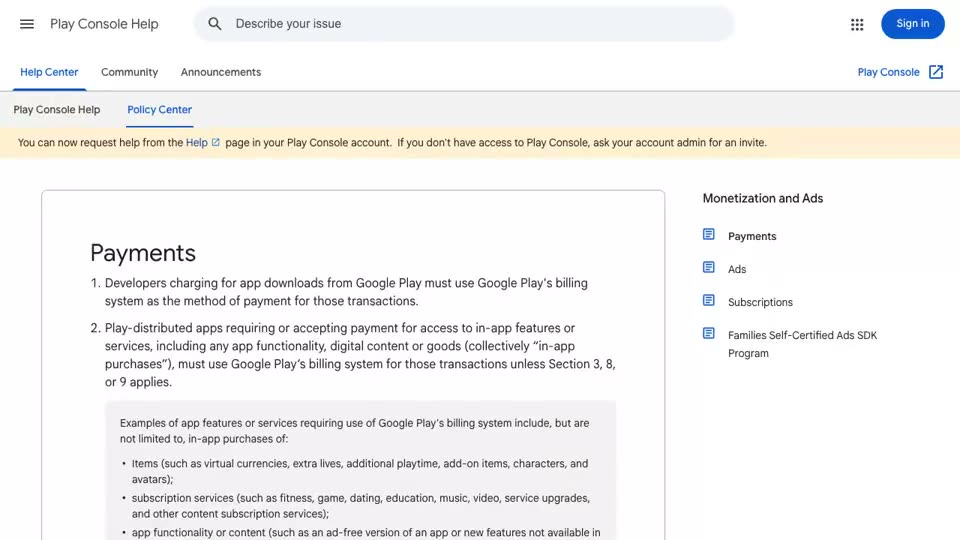
Google’s public Play Console Help page for the Payments policy, scrolled to item 7: apps and games offering randomized virtual items “including, but not limited to, ‘loot boxes’ must clearly disclose the odds” in advance of, and in close and timely proximity to, the purchase.
What the FTC’s order requires
In January 2025 the FTC announced a settlement with the maker of Genshin Impact. The complaint alleged that the company deceived players about odds, and the proposed order (which the release says needs a federal judge’s approval) sets disclosure terms:
The complaint further charged that HoYoverse deceived players about the odds of winning particular sought-after “five-star” loot box prizes and how much it would cost to open loot boxes to win the prizes. … Prohibited from misrepresenting loot box odds, prices and features; Required to disclose loot box odds and exchange rates for multi-tiered virtual currency;
The allegations are the FTC’s; the release describes a proposed order that must be approved by a federal judge.
What a disclosure looks like: one publisher’s page
Electronic Arts’ page for its football game says where its disclosure sits in the store screen and how the percentages are computed:
The percentages that you see are the minimum probability of getting one or more items in the ratings range and category listed. … Pack probabilities are calculated by simulating the opening of a very large number of packs for each pack type in the Store.
The publisher’s own description of its method. This brief does not say the disclosure meets any rule.
Korea: the decree
Korea’s disclosure duty sits in Article 33(2) of the Game Industry Promotion Act, which took effect on March 22, 2024. The Enforcement Decree, in the Korea Legislation Research Institute’s English translation, says what the duty adds to the odds themselves and who is within it:
Article 19-2 (Display of Probability of Supply for Each Type of Probabilistic Item) (1) "Matters prescribed by Presidential Decree" in Article 33 (2) of the Act means the following matters: 1. The total number of probabilistic items or the period for offering them (applicable only to probabilistic items, the total number or period for offering of which is limited); 2. Matters deemed by the Minister of Culture, Sports and Tourism as necessary to be indicated and publicly notified for the protection of the rights and interests of the users of game products, which are specified as follows: a. Matters that may have a significant impact on a game product user's decision to purchase or use a probabilistic item; b. Matters that are likely to significantly impair the reasonable judgment of the users of game products. (2) Game products subject to the duty of indication under Article 33 (2) of the Act shall be game products provided through the information and communications network, which offer probabilistic items: … (3) The content and method of indicating the information on the probability of supply of probabilistic items pursuant to Article 33 (2) of the Act are as specified in Attached Table 3-2.
Paragraph (2) excludes some game products, for example those offered to youth and general game providers and those of small enterprises under a sales threshold. Attached Table 3-2, which sets the content and method of display, was not on the page read.
The Ministry reported on enforcement in May 2024, six weeks after the duty began:
Since the launch of the disclosing probability information for probabilistic item on March 22, the MCST has detected and addressed 105 violations in 64 games related to nondisclosure of probability information through GRAC’s monitoring efforts, and has issued 6 inquiries concerning alleged false probability information.
A count as of May 8, 2024, from the Ministry. The Ministry’s later counts and the Act’s penalty provisions were not read.
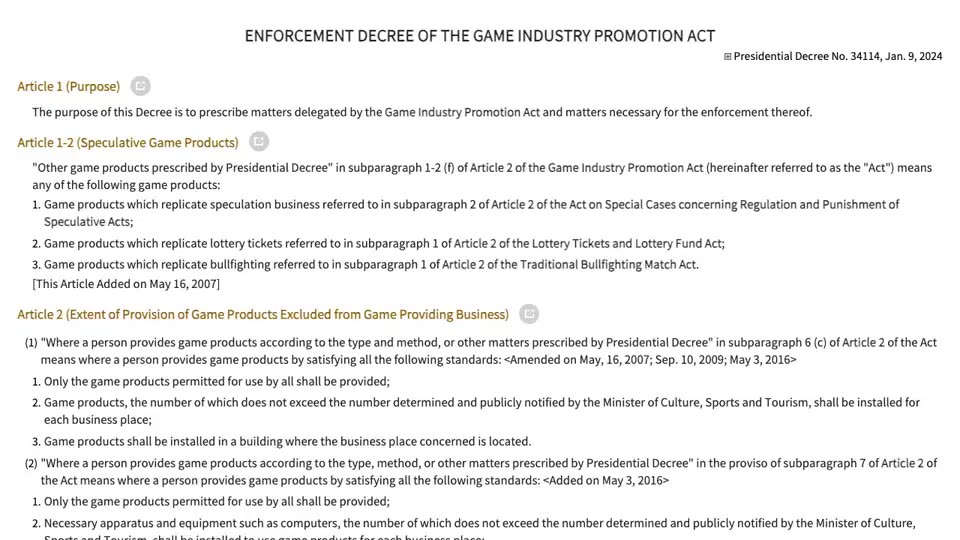
The Korea Legislation Research Institute’s public English text of the Enforcement Decree of the Game Industry Promotion Act, scrolled to Article 19-2, “Display of Probability of Supply for Each Type of Probabilistic Item”, and the articles that follow it.
China: a 2016 notice
China’s Ministry of Culture issued a notice on online game operations in December 2016. In China Law Translate’s English version, its items on random drawings set a display rule and a record rule:
(6) Where online gaming operations enterprises use random drawings to provide virtual items or value-added services, they must not require users to directly participate through methods such as adding legal tender or online games' virtual currency. Online gaming operations shall promptly display the name, properties, content and quantity of all virtual items or value-added services that might be drawn or put together, as well as the odds of drawing or putting them together, on their official website or the page for the drawing. The information displayed about random drawings shall be truthful and valid. (7) Online gaming operations enterprises shall announce the results of random drawings for obtained by participants on the official website or in a conspicuous position in the game, and store the relevant records for relevant departments' inquiries; and the period for keeping records is not to be less than 90 days.
A translation. The Ministry’s original is Chinese. Whether the notice remains in force was not checked.
What this brief did not read
- Japan’s position on kompu gacha under the Premiums and Representations Act. The Consumer Affairs Agency’s own document was not found at a public address.
- The U.S. industry’s 2019 voluntary odds-disclosure commitment. The trade association’s page was not reachable.
- Article 33 of Korea’s Act and its penalty provisions, and any later Korean amendment.
- China’s current rules, including any later measures replacing the 2016 notice.
A checklist for a game that sells randomized items
- Disclose the odds of each type of item before the purchase (Apple), and put the disclosure in close and timely proximity to the purchase (Google).
- Disclose the exchange rates where the game uses a multi-tiered virtual currency, and do not misstate the odds, prices or features (the FTC’s proposed order terms).
- Say how the numbers were computed. EA’s page states a simulation method and says the figures are minimum probabilities.
- For Korea, show the odds for each type of item and the total number or offering period where either is limited, plus the matters the Minister specifies, in the form Attached Table 3-2 sets; check whether paragraph (2)’s exclusions apply to the product.
- For China under the 2016 notice, show the name, properties, content, quantity and odds of every item that can be drawn, make the information true, publish drawing results and keep the records for at least 90 days.
- Keep one set of numbers. The same odds should appear in the store listing, in the game and on the publisher’s site.
- Re-read each rule before launch in a market. Apple’s and Google’s pages, the Korean decree and the FTC’s order status all change.