Loot boxes and skins · Brief · 7 min read
Card breaks and livestreamed pack openings: retail sale or lottery?
What California’s and New York’s tests ask, what is alleged in the pending matters over randomized card breaks, and what eBay, Whatnot and Fanatics Live require of a break in their own rules.
In a card break, a seller opens sealed boxes or packs on a livestream, and each buyer pays for a “spot” that decides which cards the buyer receives: a team, a player, a division or a draft position. Sometimes the spot is assigned at random. The question for a builder is whether that is a sale of goods or a lottery. This brief sets out the tests two states use, what the pending matters allege, and what three platforms’ own rules require of a break. It does not decide the question for any state.
The tests: three elements in California, material chance in New York
California’s definition of a lottery turns on payment for the chance of obtaining property:
319. A lottery is any scheme for the disposal or distribution of property by chance, among persons who have paid or promised to pay any valuable consideration for the chance of obtaining such property or a portion of it, or for any share or any interest in such property, upon any agreement, understanding, or expectation that it is to be distributed or disposed of by lot or chance, whether called a lottery, raffle, or gift enterprise, or by whatever name the same may be known.
New York defines gambling by staking something of value on a contest of chance, and a contest of chance by the degree of chance in the outcome:
"Contest of chance" means any contest, game, gaming scheme or gaming device in which the outcome depends in a material degree upon an element of chance, notwithstanding that skill of the contestants may also be a factor therein. … 2. "Gambling." A person engages in gambling when he stakes or risks something of value upon the outcome of a contest of chance or a future contingent event not under his control or influence, upon an agreement or understanding that he will receive something of value in the event of a certain outcome.
Both tests ask a question about each break format. Is the outcome for the buyer a matter of chance, and is the buyer paying for the chance or for the goods? A break in which each buyer picks a named team sets a different question than one in which a wheel or a draw assigns the team.
California’s grab-bag section
California also has a section for one product type: sealed packages of sports cards that have left their original packaging. Its definition of the package is the part that matters for breaks:
(a) In addition to Section 319, a lottery also shall include a grab bag game which is a scheme whereby, for the disposal or distribution of sports trading cards by chance, a person pays valuable consideration to purchase a sports trading card grab bag with the understanding that the purchaser has a chance to win a designated prize or prizes listed by the seller as being contained in one or more, but not all, of the grab bags. … (1) “Sports trading card grab bag” means a sealed package which contains one or more sports trading cards that have been removed from the manufacturer’s original packaging.
The section was added in 1994. Two law-firm alerts read it as describing repacked product and not a manufacturer’s factory-sealed pack; this brief quotes the words and does not apply them.
What the pending matters allege
Two law-firm alerts, from the same firm, describe the pending matters after reviewing the filings. According to the second alert, nearly 70 customers of Whatnot have filed arbitration demands alleging that randomized card breaks and repack breaks violate California’s lottery and gambling laws, the federal RICO statute and state consumer-protection standards. A separate qui tam suit under the California False Claims Act, filed in July 2025 and recently unsealed, names Whatnot and Fanatics Live and alleges that they run unlicensed box-break lotteries. The alert says California’s Department of Justice has declined to intervene, and that no arbitrator or court has ruled on whether randomized breaks or repacks are illegal gambling. Whatnot has denied the allegations. These points come from the alerts and not from the filings, which this brief did not obtain. The alerts say the claimants frame a randomized break as the sale of a spot that gives a chance at a team, and not the sale of cards.
eBay: a sweepstakes alongside each break
eBay’s chance-listings policy bars lotteries, raffles and random drawings, and then lists what it allows, including breaks by approved sellers:
Items not allowed include: Contests Lotteries Raffles Random drawings Items that we allow must follow these guidelines: Bonuses are allowed as long as identical bonuses are included for all buyers Case breaks, box breaks, and pack breaks may be sold by pre-approved sellers only, and the buyer must receive the entire pack, box, or slot they purchased Trading card repacks may be sold by pre-approved sellers only
eBay’s breaks page adds a no-purchase entry for each break and says what a spot does not guarantee:
No purchase is necessary to participate. Each break includes an accompanying sweepstakes that you can enter. … While the breakers will do their best to ensure everyone gets cards, there is no guarantee that every team or player will be represented in the packs opened. Some sellers offer a “hitless” guarantee or consolation prizes, but this varies by seller.
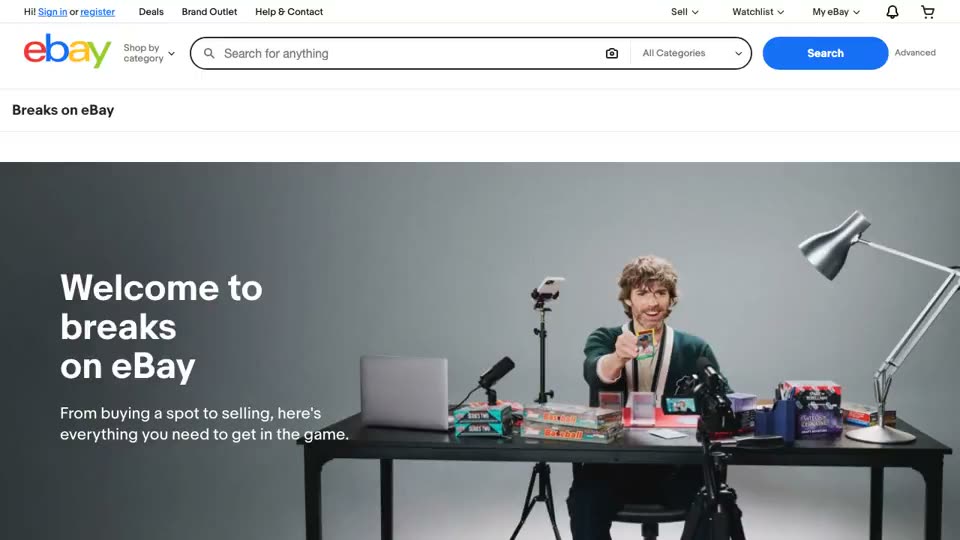
eBay’s public “Breaks on eBay” page: the three-step explainer (grab your spot, chase the thrill, claim your wins, with “No purchase necessary”), then the list of FAQ questions, including who can run breaks and what happens if no card is pulled for a spot.
Whatnot: no wheels, no prizes, a card for every buyer
Whatnot’s Card Breaks Policy, dated June 22, 2026, defines a break and then bars the randomizing tools and requires a card for every buyer:
A Card Break is a sale format where the contents of sealed product(s) are split among multiple buyers. … No mechanical or wheel-based randomization: Randomization cannot be done through a physical machine. … Additionally, sellers may not use randomizer wheels. … Every buyer must receive a card: Each buyer must receive, at a minimum, one card for each Card Break purchase. … For break formats where a seller cannot guarantee that each entrant receives a card (e.g., team breaks, where there is a chance a buyer’s selected team does not actually appear in the break), every person must be shipped, at a minimum, one card for each purchase.
Its separate gambling policy lists randomized results for a prize as gambling, and lists a break with pre-defined guarantees among its purchase-based prizes:
Raffles, races, wheels, tombolas, or other randomized results for a prize. … Offering a break with pre-defined guarantees, or bonuses separate from the sealed product that only apply to certain assignments
The two platforms differ. eBay’s page says some sellers offer a “hitless” guarantee; Whatnot’s policy lists a break with pre-defined guarantees as prohibited.
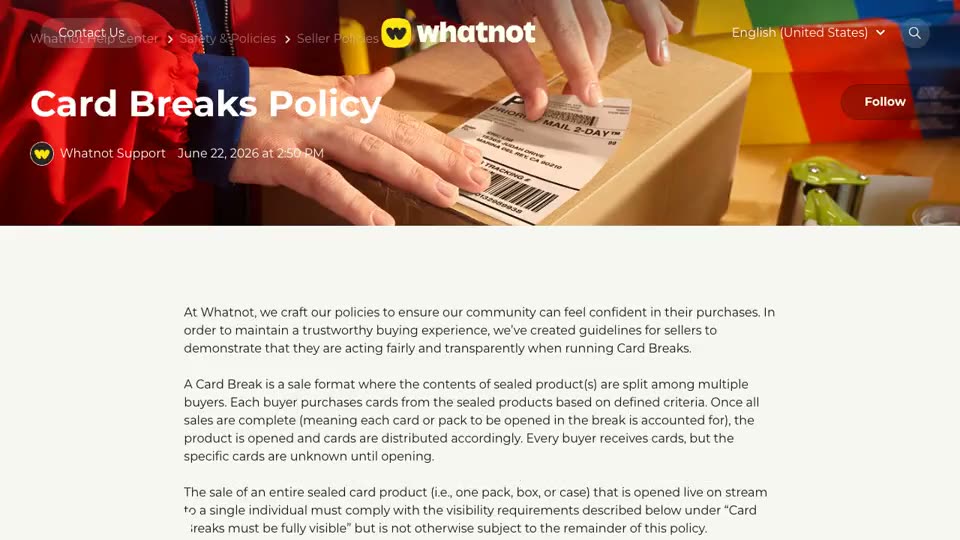
Whatnot’s public Card Breaks Policy, dated June 22, 2026: the definition of a card break, the section on item descriptions and presentation (cards-only, no wheel-based randomization), and the section on rules and conduct, including “Every buyer must receive a card”.
Fanatics Live: a receipt guarantee
Fanatics Live’s blog describes how spots are assigned and what the platform promises a buyer. Its own break policy was not found at a public address, so only the post is quoted:
They may have different rules for how spots are assigned, like by division, randomly, or by drafting teams. … With verified sellers and a card receipt guarantee, you will know that something is coming your way any time you buy into a break.
A checklist for a break format
- Say which question the format poses. A named-team or hit-draft format and a randomly assigned one ask different questions of California’s “chance” element and New York’s “material degree” test.
- Name the consideration. Each buyer pays for a spot. California asks about payment “for the chance of obtaining such property”; New York asks about staking something of value. The platforms’ no-purchase entry and every-buyer-gets-a-card rules speak to this element.
- Check which product is in the pack. Section 319.3 speaks of cards “removed from the manufacturer’s original packaging”; a break of factory-sealed product and a repack are different products.
- Read the platform before the statute. eBay allows breaks by approved sellers and attaches a free entry; Whatnot bars wheels, prizes and outcome-tied guarantees and requires a card for each buyer. A format allowed on one is listed as prohibited on the other.
- Keep the listing rules where the buyer sees them. Whatnot requires a break’s rules, including how base and bulk cards are handled, in the show notes or the listing.
- Treat the pending matters as undecided. The allegations are described in alerts, no ruling has been reported, and the filings were not read for this brief.
- Keep a record of each break: spots sold, assignment method, cards shipped to each buyer.